










Most Shopify merchants searching for Elevar alternatives want one of three things: a setup they don’t have to maintain themselves, expert help included, and a price that’s worth it.
Below, we compare five options for accurate Shopify data tracking in 2026, along with what Elevar itself costs today, so you have a clear baseline to measure against.
Each tool approaches tracking differently. Understanding where each one is strong, and where it stops, helps you pick the right app the first time.
A Quick Look at Elevar
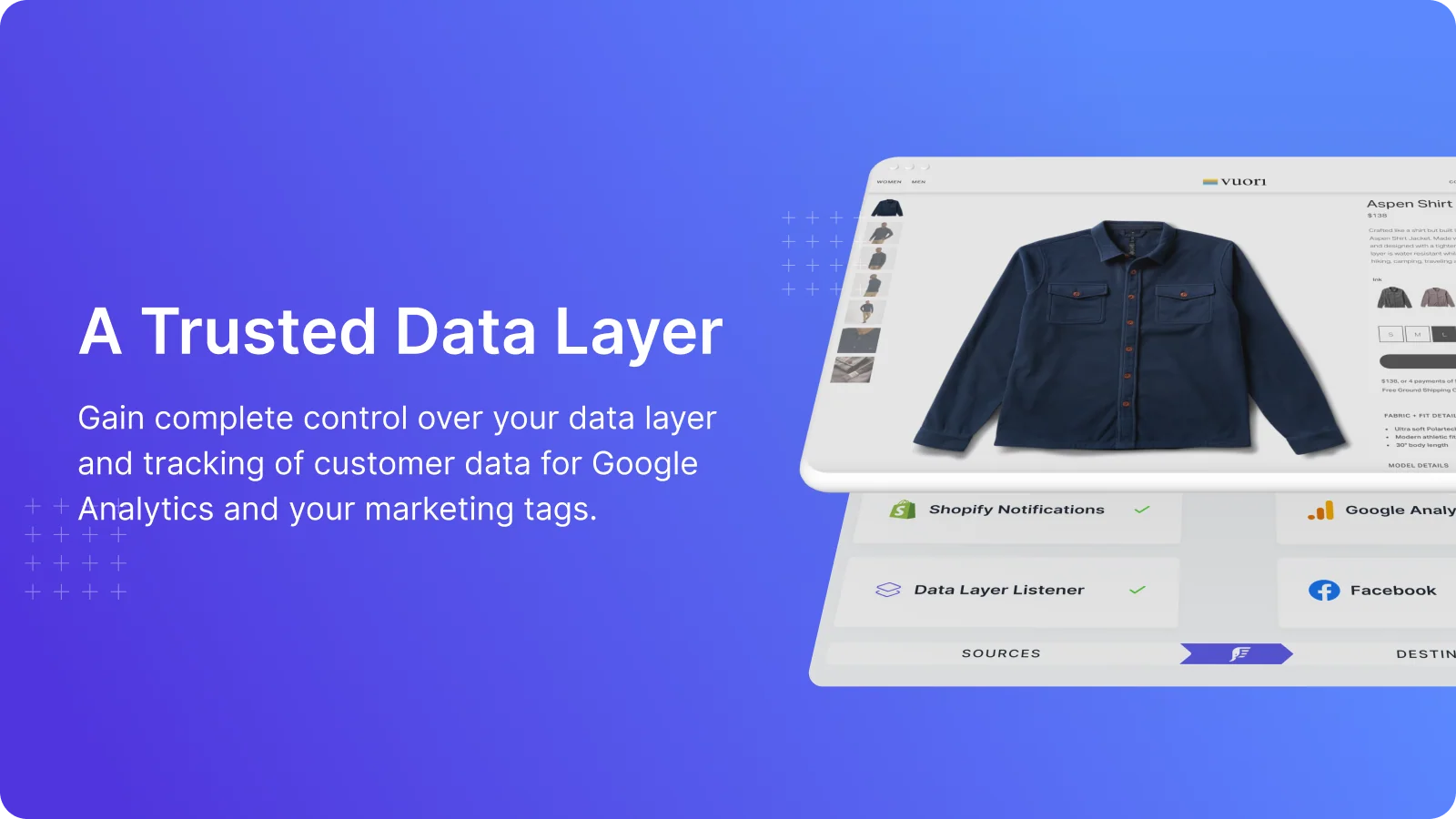
Before comparing alternatives, it helps to know what you’re comparing against.
- Price: From $225/month, scaling with monthly order volume and the number of destinations you track
- Rating: 4.6★ (137 reviews, 91% five-star)
- Trial: 15 days. No free plan.
Elevar, now known as Audiense Online powered by Elevar, is a conversion tracking platform for Shopify stores, including headless builds.
Where Elevar is strong
Here are some of the capabilities of Elevar.
- 40+ destinations across six categories: Advertising (Google Ads, Meta, TikTok, Pinterest, Reddit, X, Spotify, Microsoft Ads, OpenAI and more), analytics, affiliate and influencer networks (AWIN, CJ, Impact, Rakuten), attribution and BI (BigQuery, Google Pub/Sub), and email/SMS (Klaviyo, Attentive, Braze, Postscript, Omnisend)
- Identity resolution and session enrichment: Recognizes returning users and preserves session context across visits, capturing customer, marketing, cookie and user ID signals.
- Multi-storefront under one plan: Track multiple stores or storefronts without separate licences
- Broad subscription app compatibility: Recharge, Skio, Smartrr, Ordergroove, Bold and Upscribe
- API framework on higher tiers, extending beyond Shopify to Magento/Adobe, WooCommerce and Salesforce Commerce Cloud
Note that several headline features, including custom events, custom triggers, predicted lifetime value and comeback scoring, are listed as coming soon rather than currently available.
Elevar’s pricing structure
| Plan | Price | Orders | Destinations | Destination types | Overage |
|---|---|---|---|---|---|
| Core | $225/mo | 2,000 | Up to 2 | Advertising, analytics only | $0.50/order |
| Advanced | $650/mo | 10,000 | Up to 4 | All six categories | $0.15/order |
| Premium | $1,250/mo | 30,000 | Up to 10 | All six categories | $0.10/order |
| Elite | $3,000/mo | 75,000 | Up to 25 | All six categories | $0.04/order |
Why merchants start looking at Elevar alternatives
- Destination limits, and destination types: Your plan is set by whichever cap you hit first. Core allows two destinations and only advertising or analytics ones, so a store that wants Klaviyo tracking, or an affiliate network, has to move to Advanced at $650/month regardless of order volume.
- Core can’t be extended: Additional destinations are available at $125/month each, but only from Advanced upward. On Core, needing a third destination means upgrading the plan.
- Order-based pricing with overages: Extra orders are charged individually on top of your plan, at $0.50 each on Core. Peak periods like Black Friday are where merchants most often report unexpected charges.
- Setup and support are priced separately: Expert installation is $1,000 one-time, or $4,500 for headless storefronts. Ongoing analyst support is $500/month for up to three requests, or $1,000/month for up to ten, and it’s only available from Advanced upward.
- Setup complexity: The GTM data layer is optional, but implementation still runs through a data layer and container configuration. That’s more moving parts than a lean Shopify store usually needs, and it’s the most frequently reported friction point among merchants.
- No embedded reporting: Elevar delivers data to your platforms rather than reporting inside Shopify, so you’re still switching tools to read it.
Top Elevar Alternatives at a Glance
| Tool | Starting price | Pricing model | Rating | Destination limits | Server-side | Expert setup included |
|---|---|---|---|---|---|---|
| Elevar | $225/month | Orders + destinations | 4.6★ (137+) | 2 to 25 by plan, +$125/mo each | Yes | No (+$1,000) |
| Analyzify | $145/month ($1,305/year) | Orders, flat tiers | 4.7★ (272+) | None, 10+ included | Yes | Yes (yearly plans) |
| Littledata | Free to install, $0.35/order | Per order, or tiers from $199/month | 4.8★ (124+) | None stated | Yes | Managed onboarding on Plus |
| Triple Whale | Free plan, then $219/month | By annual GMV and package | 4.1★ (85+) | None stated | Server-side delivery, pixel-sourced | Varies by tier |
| Google & YouTube | Free | Per order, or tiers from $199/month | 4.5★ (5,098+) | Google only | Purchase event only | No |
| TrackBee | $79/month | By tracked revenue | 4.3★ (9) | None stated | Yes | Only included in the Scale plan |
Top 5 Elevar Alternatives for Data Tracking
Here are the most popular Elevar alternatives Shopify merchants consider when it comes to conversion tracking.
Analyzify
- Price: Standard from $145/month ($1,305/year, up to 5K orders); Plus from $275/month ($2,475/year, up to 50K orders). Volume tiers scale to 300K orders/month.
- Rating: 4.7★ (272+ reviews)
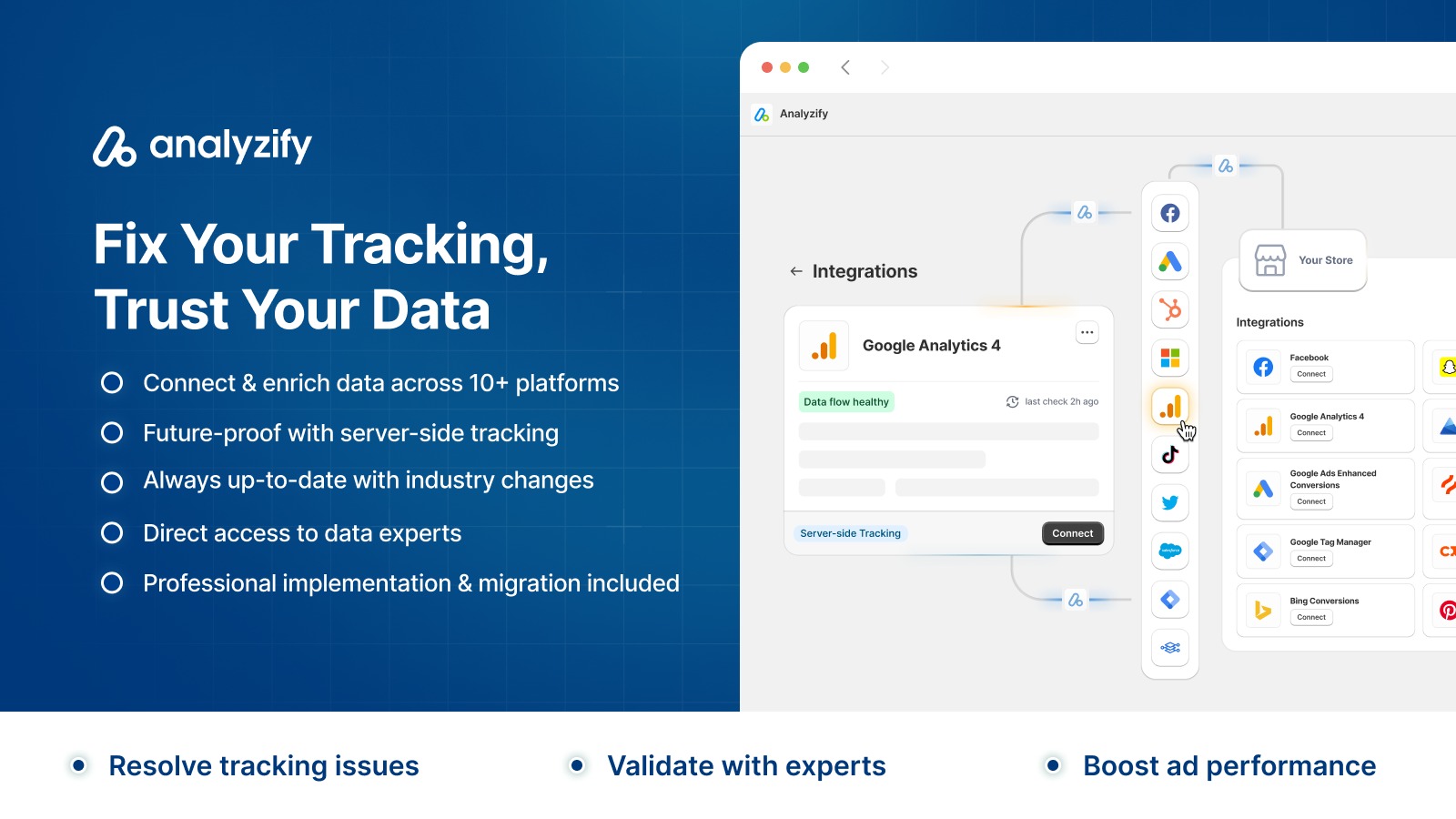
Analyzify is a turnkey Shopify tracking app built to help merchants fix their data and trust their numbers. It combines client-side and server-side tracking, and Professional Implementation (audit, setup, and validation by the Analyzify team) is included with yearly plans at no extra cost.
Expert installation and ongoing support are included rather than charged at $1,000 and $500/month. All 10+ platform integrations are available on every plan, so adding TikTok or Klaviyo to your stack doesn’t move you into a higher tier or add a per-destination fee.
Analyzify also offers a built-in marketing analytics dashboard so you get your most important metrics without switching to another platform.
Key Features of Analyzify
- Unified Pixel: 10+ platforms through a single pixel that updates automatically, with no code changes on your side and no per-destination limits or fees
- Server-side tracking: Built-in server-side tracking for GA4, Meta, TikTok, and Klaviyo included in your plan
- Purchase attribution: Order-level attribution showing the full path to purchase, with first, middle, and last-touch journeys and four attribution models
- Campaign-Level & Channel-Level attribution: Aggregated revenue and order counts per campaign across attribution models + revenue & order performance grouped by marketing channel
- Marketing Analytics Dashboard: 30+ reports covering GA4, Google Ads, Meta, TikTok, Klaviyo, and Search Console, inside your Shopify admin
- Profit Dashboard: Net profit, COGS, MER, and campaign-level profitability
- Audience segments & RFM analysis: Automatic customer segmentation with list sync to Google, Klaviyo, and Shopify
- Advanced tracking controls: Refund tracking, COGS in Google Ads, form tracking, and custom events
- Server-side GTM: Hosted via Stape or your own Google Cloud project, set up and maintained by the Analyzify team
- Headless & custom storefronts: Full tracking for Hydrogen, Oxygen, and custom builds via SDK
- Full GDPR compliance: Consent Mode v2, CCPA, and Shopify Customer Privacy API integration
How it differs from Elevar
- Setup, validation and ongoing support are included with yearly plans, rather than $1,000 for installation and $500/month for analyst requests
- No destination caps or per-destination fees, so your platform count never changes your price
- Reporting lives inside Shopify, with attribution and marketing analytics in your admin rather than only in your connected platforms
- Flat volume tiers, so your cost steps up with orders rather than with every channel you add
Best for: Merchants who want reliable tracking without managing it, and who’d rather have setup, validation, and ongoing support included than billed separately.
🔎 Take a closer look: what Analyzify offers
🔗 See the full breakdown: a detailed comparison of Elevar vs. Analyzify.
Littledata
- Price: Flex is free to install at $0.35 per tracked order with no monthly minimum. Scale is $199/month (1,500 orders included) and Plus is $990/month (10,000 orders included). Annual billing saves 20%, bringing Scale to roughly $159/month and Plus to $792/month.
- Rating: 4.8★ (124+ reviews)
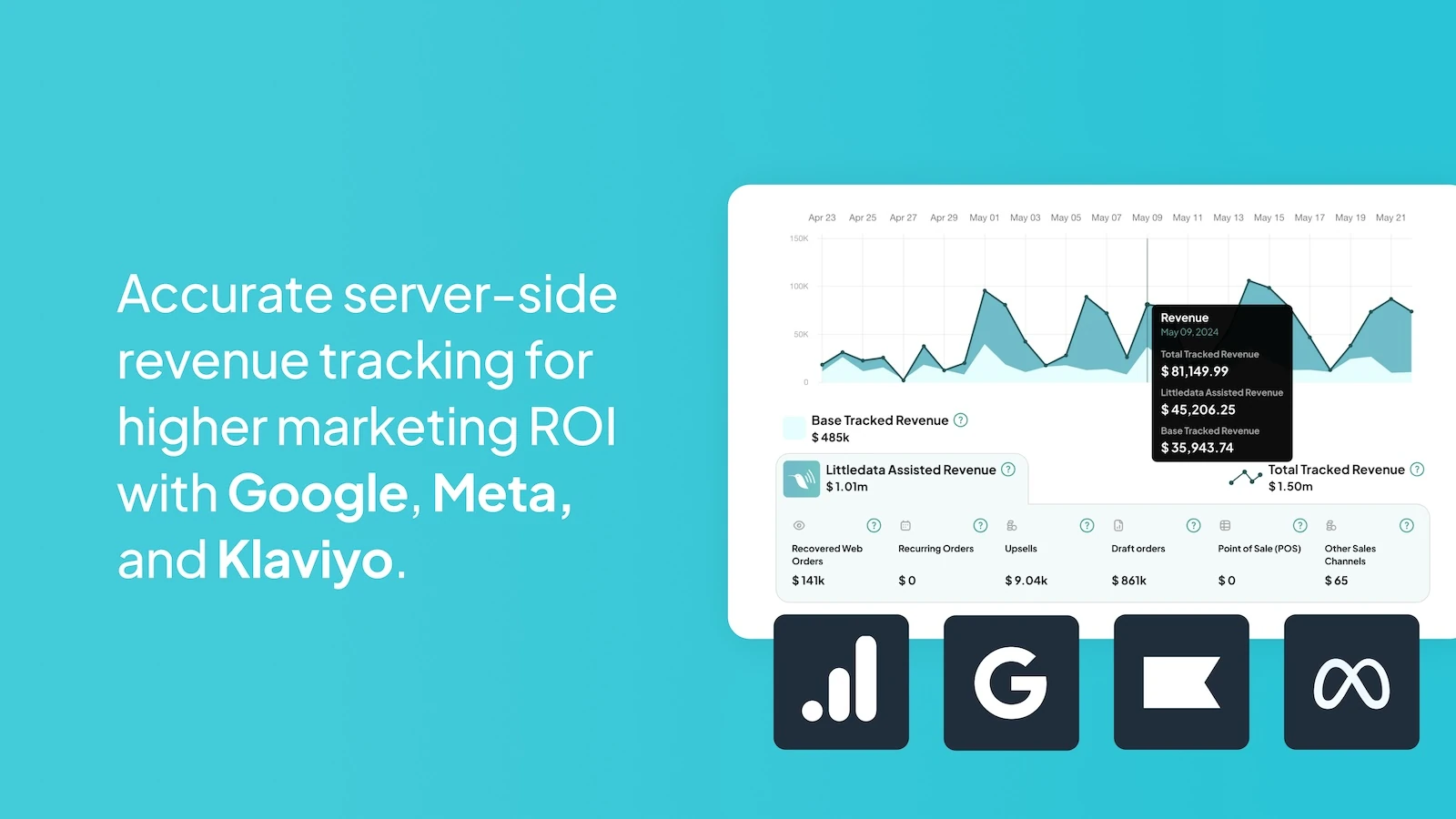
Littledata positions itself as a customisable data layer for Shopify, and like Analyzify it requires no Google Tag Manager and no developer. It sends first-party signals to GA4, Google Ads, Meta, Microsoft Ads, TikTok, Pinterest, Klaviyo, Attentive and Recharge.
Key Features of Littledata
- Server-side tracking to Google, Meta, Klaviyo, and more
- Event Editor: Enrich events with Shopify metafields and filter by rules, with no code
- Profit Signal: Sends margin data to Google Ads and Meta so campaigns optimise on profit rather than revenue
- Multi-store rollups, multi-currency, managed onboarding and an uptime SLA (Plus)
- Bot protection and unlimited Shopify Markets support
- Headless and Hydrogen tracking (Scale and above)
Littledata’s per-order Flex pricing is genuinely useful for smaller stores, since you only pay for what you track. The trade-off is that costs climb with volume, so it’s worth modelling your own order count against both the per-order rate and the tiered plans.
How it differs from Elevar
- No destination caps or per-destination fees: every integration is available on every plan, including the free-to-install tier
- Per-order pricing available on Flex, rather than fixed monthly tiers only
- No GTM container or tagging server to maintain
- Built GA4-first, with Segment available from Scale upward
Best for: Stores where GA4 accuracy is the priority, and smaller merchants who prefer paying per order rather than a monthly fee.
🔎 Take a closer look: how Littledata works
Triple Whale
- Price: Free plan available. Foundation is $219/month ($2,190/year, saving 17%) and Automate is $749/month ($7,490/year) as listed on the Shopify App Store. Triple Whale’s own pricing page states that prices are set by a combination of annual GMV and package, so your actual cost depends on your revenue band, and charges may be billed separately from your Shopify invoice.
- Rating: 4.1★ (85+ reviews)
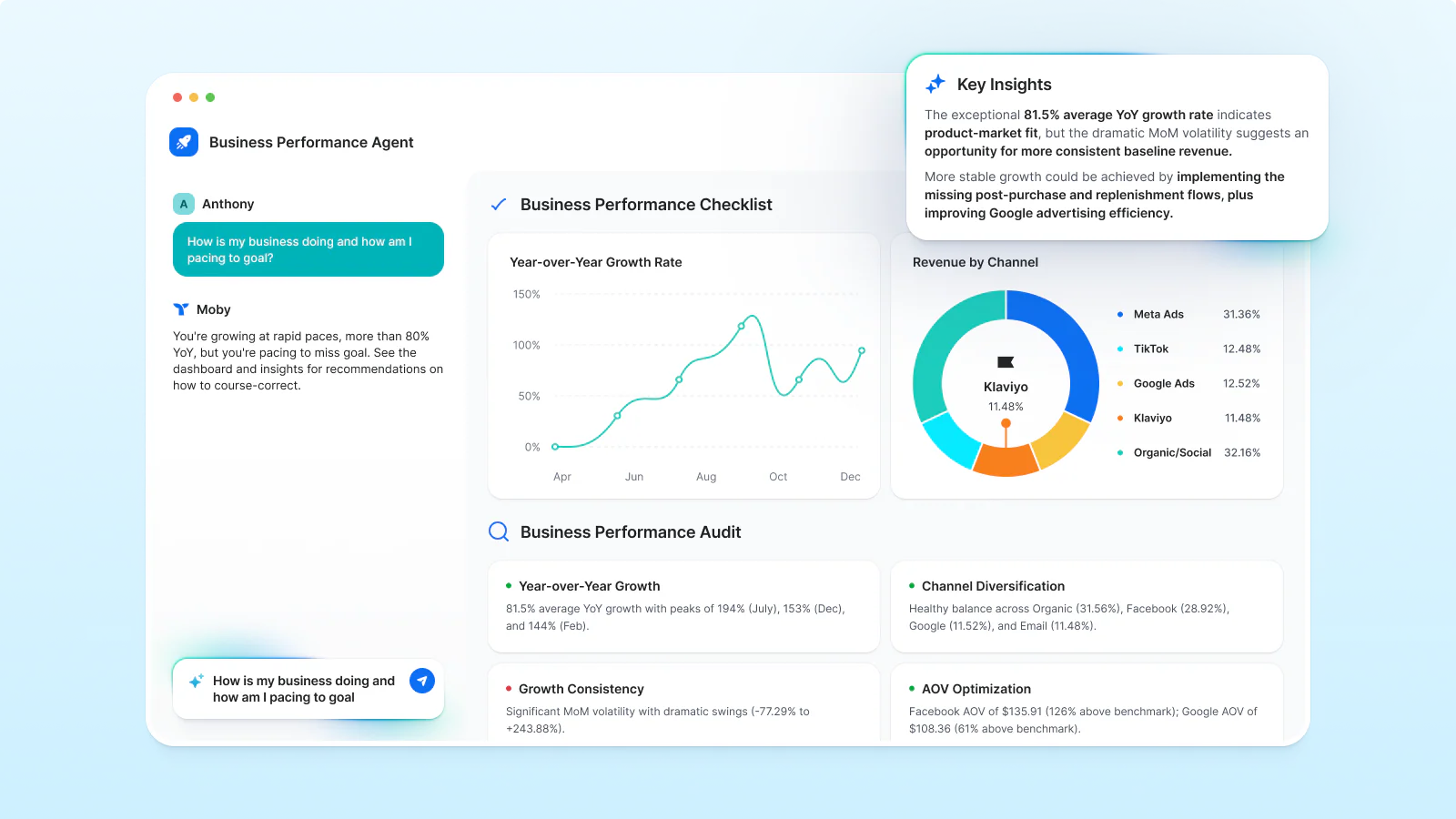
Triple Whale has repositioned as an AI operating system for ecommerce, built around Moby 2, an AI operator that works inside your ad accounts, drafts campaigns, builds creative and runs recurring tasks on a schedule. It installs its own Triple Pixel and consolidates signals from more than 60 integrations into one platform.
Key Features of Triple Whale
- Moby 2: AI operator for campaign management, creative generation and scheduled automations
- Compass: Marketing mix modelling, multi-touch attribution and incrementality testing
- Sonar: Enriches Triple Pixel events with first-party data from Shopify and delivers them to ad platforms server-side, including Meta via the Conversions API
- Triple Pixel for cross-device behavioural tracking and identity resolution
- Custom dashboards, SQL editor, cohort analysis and segmentation builder (Foundation)
- Post-purchase surveys, with the standard version available on the free plan
- SOC 2 Type II, GDPR and CCPA compliance
Triple Whale takes a fundamentally different approach from Elevar, Littledata or Analyzify. Rather than improving the accuracy of the platforms you already report on, it collects behaviour through its own Triple Pixel and becomes the place you look.
Its attribution, marketing mix modelling and AI recommendations all run on that internal dataset. Sonar does push enriched events server-side to ad platforms including Meta via the Conversions API, so there is overlap with a tracking tool, but GA4 is not among its destinations and reconciling Shopify’s numbers against your platforms isn’t what the product is designed to do.
For brands that want a single blended view and are happy for that view to be Triple Whale’s, this works well. For brands that need GA4, Google Ads and Meta to report accurately in their own right, it doesn’t replace a tracking setup, which means running both and paying for both.
Multi-touch attribution requires Foundation, since the free plan covers first and last-click only. And AI usage is metered, with reviewers on the Foundation tier noting they hit limits and needed to purchase additional credits.
How it differs from Elevar
- Not a like-for-like replacement: it becomes your reporting layer rather than improving accuracy in GA4 and your ad platforms
- Data is collected through its own pixel, so the transport is server-side but the event originates in the browser rather than from Shopify’s order record
- GA4 is not among Sonar’s destinations
- Priced by annual GMV rather than order volume, so your bill tracks company revenue rather than how much you use the product
Best for: Brands with substantial ad spend that want blended attribution, marketing mix modelling and AI-driven workflow automation on top of an existing tracking setup.
Google & YouTube
- Price: Free
- Rating: 4.5★ (5,098+ reviews)
Shopify’s native Google integration connects your store with Google Merchant Center, Google Ads, and Google Analytics in a few steps. It’s the free baseline for tracking.
Key Features of Google & YouTube
- Direct Shopify and GA4 connection
- Server-to-server purchase tracking: Since July 2026, purchase events are sent directly from Shopify’s servers to Google Analytics and Google Ads, with Google handling deduplication against browser events via transaction IDs
- Basic e-commerce event tracking (purchase, add to cart, view item)
- Google Ads and YouTube integration
- No-code installation, activated automatically
- Automatic linking with Google Merchant Center
The server-to-server addition is a real improvement, and it costs nothing. Purchases that would previously have been lost to ad blockers, privacy browsers, or a customer closing the tab now reach GA4 regardless of what the browser does.
Its limits are about scope rather than reliability. The integration covers the purchase event only. View item, add to cart, and every checkout step still depend on browser tracking, so upper-funnel data remains subject to the same signal loss as before. It also covers Google’s ecosystem only, so if you advertise on Meta or TikTok, those platforms see no benefit and still rely on their own pixels or conversion APIs.
🔗 We covered this in detail: how Google’s native Shopify server-to-server integration works.
How it differs from Elevar
- Free, with no order volume or destination pricing
- Server-side coverage is the purchase event only, where Elevar covers the full event set
- Google destinations only, so no Meta, TikTok, Klaviyo or other platform support
- No expert setup, validation or ongoing support
- No enriched ecommerce parameters such as coupon codes, SKUs or payment methods
Best for: New or small stores that need a free GA4 and Merchant Center connection, and any store as a baseline layer underneath a broader setup.
🔎 Take a closer look: what Google & YouTube app offers
TrackBee
- Price: Start is $79/month covering $25K monthly tracked revenue, Pro is $199/month covering $100K, and Scale is $449/month covering $500K. Above that, pricing is custom. Overages are charged per $1K of extra tracked revenue. TrackBee Insights is $19.99/month on top of any plan.
- Rating: 4.3★ (9 reviews, listed as TrackBee Connect)
TrackBee is a tracking app built around server-side event delivery and cross-device identity. You create an account on TrackBee’s site, add your store to generate an API key, then install the free TrackBee Connect app in Shopify and enable its app embed to activate tracking.
Key Features of TrackBee
- Server-side event delivery to Meta via CAPI, Google Ads via Enhanced Conversions, TikTok via Events API, Pinterest, Microsoft Ads, GA4 and Klaviyo
- All 19 integrations included on every plan, with nothing locked behind higher tiers
- Persistent shopper profiles that stitch sessions across devices and browsers
- Event enrichment with first-party Shopify data including products, cart contents, order value and customer identifiers
- Automatic deduplication against your existing pixels, which keep running alongside
Its focus is getting complete, enriched events into ad platforms and Klaviyo rather than producing reporting you read inside Shopify. Analysis happens in your connected platforms, or through the paid Insights add-on, which connects your data to Claude or ChatGPT for conversational querying.
The pricing model is the thing to understand before comparing headline numbers. Plans are priced by tracked revenue, not order volume, and the included allowances are lower than they first appear. The $79 tier covers $25K of monthly revenue, which is roughly $300K a year, with $6 charged per additional $1K. A store turning over $50K a month on that plan would pay around $229. Because the basis is revenue rather than orders, higher average order values push you up the tiers faster. Personal onboarding is included from the Scale plan at $449/month. Below that, setup is self-serve.
How it differs from Elevar
- No GTM container or tagging server to maintain
- Priced by tracked revenue rather than order volume, so your bill moves with sales rather than order count
- All 19 integrations included on every plan, with no per-destination fees
- Onboarding is included only from the Scale plan at $449/month, where Elevar sells installation as a one-time fee
Best for: Smaller and mid-sized Shopify brands that want server-side delivery to ad platforms and Klaviyo, and that already have reporting and attribution handled elsewhere.
Elevar Alternatives Pricing Compared
Tracking apps price on four different bases, and that matters more than the headline number. Elevar charges by order volume and destination count. Littledata charges per order or by tiered plans. TrackBee charges by tracked revenue. Triple Whale charges by annual GMV. Analyzify charges by flat order tiers.
What each tool costs at different volumes
Annual cost at each volume, using the cheapest plan available from each vendor.
| Monthly orders | Analyzify | Elevar | Littledata | TrackBee |
|---|---|---|---|---|
| 500 | $1,305 (Standard) | $2,700 (Core) | $2,100 (Flex) | $2,388 (Pro) |
| 5,000 | $1,305 (Standard) | $7,800 (Advanced) | $6,528 (Scale) | $5,388 (Scale) |
| 10,000 | $1,575 (Standard) | $7,800 (Advanced) | $10,128 (Scale) | $9,888 (Scale) |
| 30,000 | $2,475 (Plus) | $15,000 (Premium) | $19,080 (Plus) | Custom |
How these were calculated:
- Analyzify: annual plan prices, with Professional Implementation included. Standard covers up to 20,000 orders per month, Plus from there.
- Elevar: twelve months at published monthly rates, using the cheapest tier at each volume rather than staying on a lower plan and paying overages. The 500-order figure assumes Core’s two-destination limit; a store tracking four destinations needs Advanced at $7,800 regardless of volume.
- Littledata: the cheapest of Flex, Scale or Plus at each volume, including published overage bands. Figures use monthly billing. Annual billing takes 20% off the base fee, which brings the 5,000-order figure to $6,048 and the 30,000-order figure to $16,704.
- TrackBee: priced on tracked revenue rather than orders, so this column assumes a $100 average order value. At that AOV, 5,000 orders is $500K of monthly revenue. Above $2M monthly revenue TrackBee quotes individually, which is why 30,000 orders shows as custom.
- Triple Whale: not shown as a column, because its pricing is set by annual GMV rather than order volume. The Shopify App Store lists Foundation at $219/month and Automate at $749/month, but Triple Whale’s own pricing page states that prices combine annual GMV with the package you choose, and the listing notes charges may be billed separately from your Shopify invoice. At $100 AOV, 5,000 orders a month is roughly $6M annual GMV, well above the band those published figures cover.
What to Look for in an Elevar Alternative
The most effective Shopify tracking apps are the ones that deliver long-term reliability, not just a feature list. Before choosing, consider:
- Pricing model: Does your cost scale with order volume, revenue, or destination count, or stay flat as you grow?
- Destination limits: Can you add platforms without changing plans or paying per destination? Are all destination types available on your tier?
- Client-side and server-side: Does it offer both, or rely only on browser-based scripts?
- Who does the setup: Is implementation handled and validated by experts, or are audits, configuration, and error checks your job?
- Support model: Is help included, capped by request count, or billed monthly on top?
- Server-side GTM: If you need it, is it managed for you, or do you maintain the tagging server yourself?
- Data accuracy: How does it handle refunds, cost of goods, and reconciliation against Shopify’s own order data?
- Source of truth: Does it rely on a separate tracking pixel, or use Shopify’s verified order and event data?
- Platform changes: Does it stay aligned with Shopify’s updates, like Checkout Extensibility and the Web Pixels API?
- Compliance: Does it support Consent Mode v2 and GDPR-compliant tracking properly?
- Peak season: What happens to your bill during Black Friday order spikes?
- Roadmap vs reality: Are the features you’re buying available now, or listed as coming soon?
A professional setup followed by continuous validation keeps your data flow consistent even when Shopify or the ad platforms change how things work. That includes confirming every event fires correctly and that all important e-commerce parameters carry the right values.
A professional setup followed by continuous validation keeps your data flow consistent even when Shopify or the ad platforms change how things work. That includes confirming every event fires correctly and that all important e-commerce parameters carry the right values.
Switching from Elevar Without Losing Data
Migrating tracking tools makes merchants nervous, and reasonably so. Attribution history, conversion continuity, and ad platform optimization all depend on your data staying intact. Here’s what a clean migration actually involves.
1. Audit the existing setup. Before anything is removed, your current implementation needs mapping: which events fire from where, what’s running through GTM, what’s hardcoded in the theme, and what’s left over from previous tools. Most stores have more accumulated tracking than they realize.
2. Run both setups in parallel. New conversion actions are created alongside the existing ones rather than replacing them. Your campaigns keep optimizing on data you already trust while the new setup proves itself.
3. Validate against Shopify. Compare orders and revenue in your platforms against Shopify’s own numbers over two to four weeks. This is where discrepancies surface, and where they should be fixed, before anything becomes your primary source.
4. Decommission cleanly. Once validation is complete, the old data layer, container configuration, and any tagging server can be retired. Removing them too early is the most common cause of data gaps during a migration.
5. Keep your historical data. Data already in GA4, Google Ads, or Meta stays there. You’re changing how new data arrives, not replacing your history.
With Analyzify, this process is handled for you as part of Professional Implementation, included with yearly plans.