










A shopper lands on your product page. They have some questions about sizing, materials, return policy, compatibility.
They scroll down but can’t find the relevant answer, and leave.
That’s the most direct case for FAQs on Shopify product and collection pages. But there’s more to having FAQ content on your Shopify store than just conversion:
Well-structured FAQ content is also a search signal, an AI visibility asset, and for most stores a management problem waiting to happen as the catalog grows.
In this post, we cover why FAQs matter, where most stores get the strategy wrong, and how to handle it in a way that actually scales.
Key takeaways:
- FAQs reduce purchase hesitation and support volume when placed on the right pages
- FAQPage schema makes your Q&A content readable to both search engines and AI tools
- Most stores only add FAQs to product pages, missing the collection page queries where buyers have the most questions
- Managing FAQs page by page creates inconsistency and update complexity as your catalog grows
- A centralized FAQ system lets you create once, assign anywhere, and update everywhere automatically
Why FAQs on Product and Collection Pages Matter
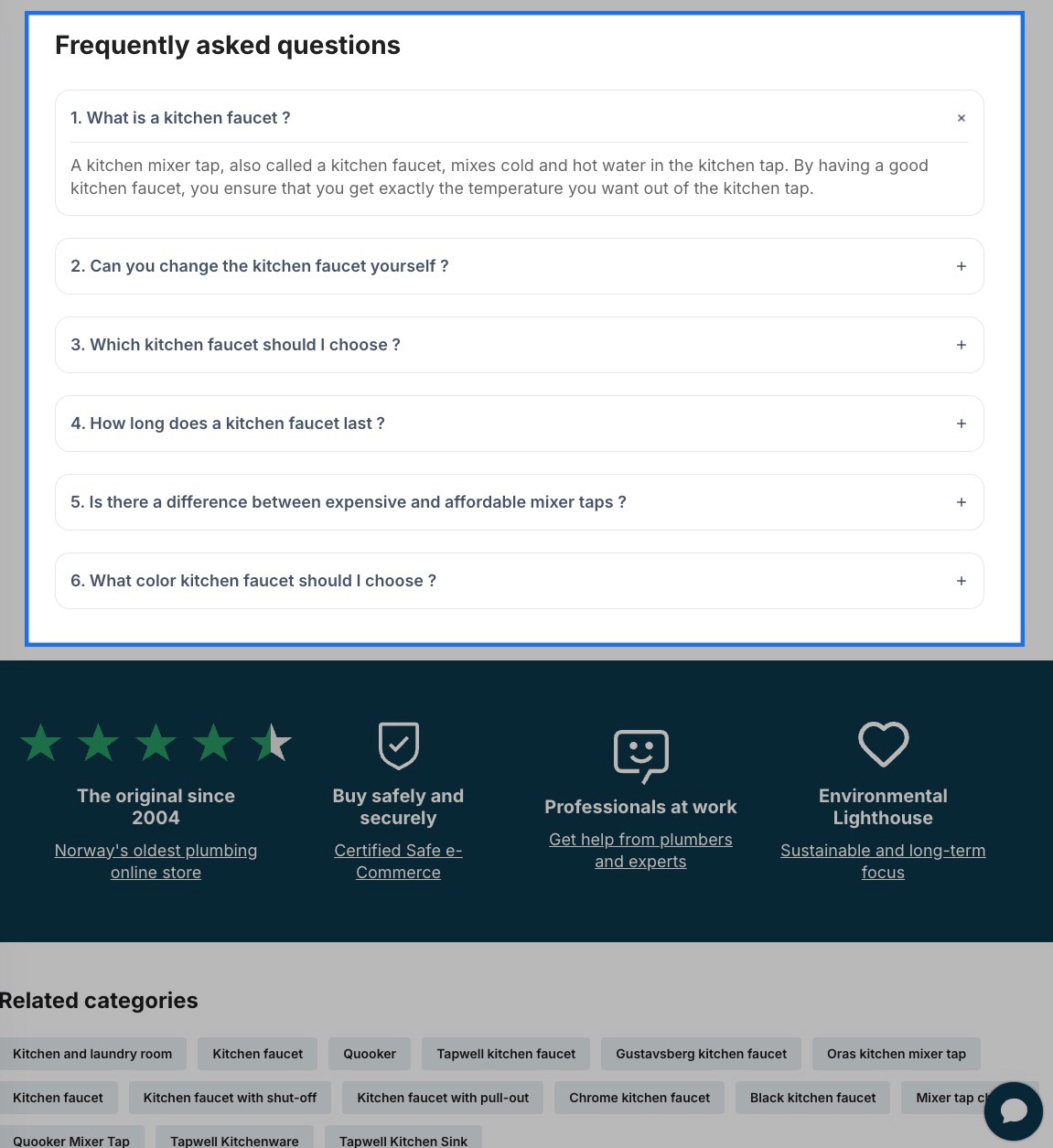
The most immediate reason to add FAQs to your pages is also the simplest: unanswered questions cost you sales.
A shopper who can’t find out whether a product fits their use case, what the return window is, or how a material holds up over time doesn’t wait around. They find the answer somewhere else, usually on a competitor’s page.
FAQs placed directly on product and collection pages intercept that. The answer is already there, in context, at the point where the question arises. That reduces hesitation without requiring the shopper to contact support or leave the page.
The support angle matters too. When the same questions get answered on the page, they stop arriving in your inbox. Stores with well-maintained FAQ content consistently see fewer repetitive support tickets on the topics those FAQs cover. At scale, that’s a meaningful reduction in support overhead.
What FAQ Schema Does for Search and AI Visibility
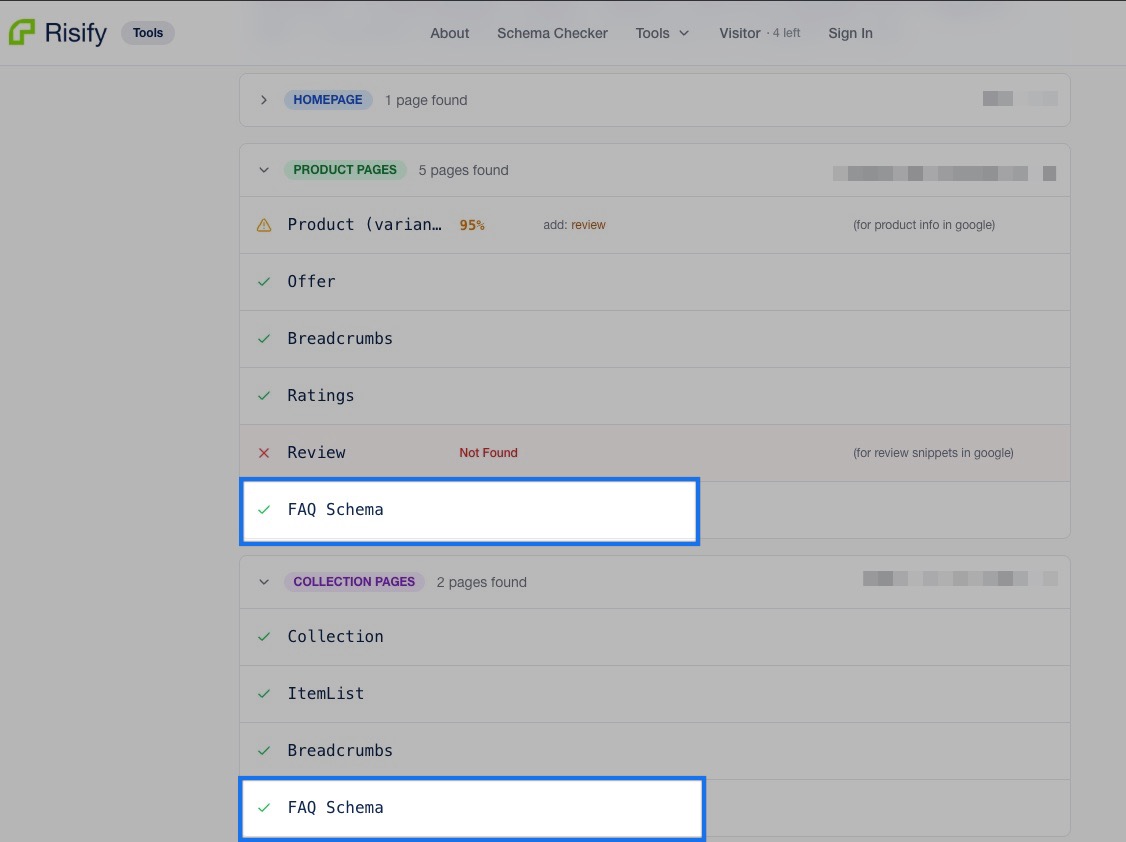
Adding FAQ content to a page is one thing. Marking it up with FAQPage schema is what makes it useful to AI platforms like ChatGPT, Perplexity, Gemini, and more.
FAQ schema (formally called FAQPage structured data) labels each question and answer as an explicit pair in a format search engines and AI tools can understand.
Without it, a crawler or AI system sees a block of text and has to infer which parts are questions and which are answers. With it, each pair is declared directly: this is the question, this is its answer.
FAQs for Rich Results
In the past, valid FAQ schema could trigger expandable dropdowns in Google search results, giving your listing more visual space than competitors.
Google has significantly restricted this feature since 2023. For most ecommerce stores, those dropdowns no longer appear. The feature is now limited to government sites, major brand pages, and health authority sources.
This is worth knowing upfront because some guides still present FAQ rich results as a primary reason to implement the schema. For a Shopify store, that’s not the realistic outcome.
Why You Should Set Up FAQs
The practical value of FAQ schema now sits in two places:
Search engines use structured data to understand what a page is about, not just what words it contains. A product page with FAQ schema answering “How do I clean this material?” is explicitly marked as containing care information. Google doesn’t have to infer it. This influences how the page is categorized and evaluated for question-based queries, and well-structured FAQ content has a better chance of appearing in People Also Ask results than the same information buried in paragraphs.
AI tools extract structured FAQ content directly. When a user asks ChatGPT, Perplexity, or Gemini a question that matches content on your page, structured Q&A pairs are easier for those systems to identify, extract, and cite than unstructured text. Both Google and Microsoft have confirmed that structured data helps their AI systems process web content more accurately. We covered the full research breakdown in What Microsoft and Google Reveal About Structured Data and AI Visibility. FAQ schema is part of that structured data foundation that helps to make your Shopify store visible to AI platforms.
The Two Problems with How Most Stores Manage FAQs
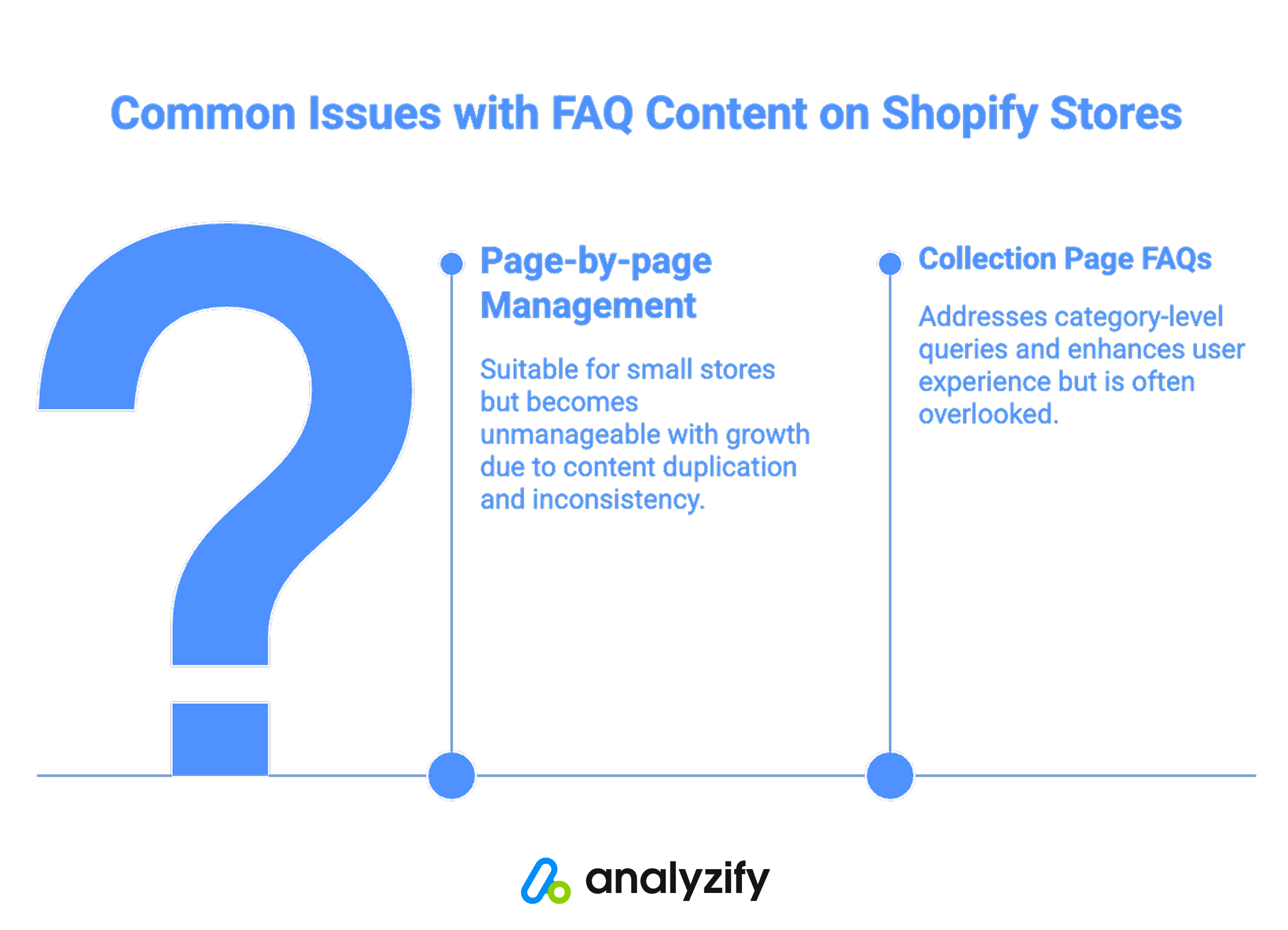
Here are the most common problems about managing FAQs in Shopify:
Problem 1: Page-by-page Management
The default approach to FAQs in most Shopify stores is to handle them at the page level.
You open a product, add an FAQ section, write the questions and answers for that product, then move to the next one. Either you rewrite similar content from scratch or copy-paste from the previous page.
This works for ten products. It breaks down at a hundred.
When your return policy changes, you now need to find and update every product page where that answer appears. Miss one, and different pages show different answers to the same question. Customers notice.
Support teams get confused about which version is current. The content exists. It’s just inconsistent and increasingly hard to maintain.
Problem 2: The Collection Page Gap
Most stores add FAQs exclusively to product pages. Collection pages get left out.
This is a significant missed opportunity because collection pages and product pages attract fundamentally different queries.
A product page typically ranks for specific, purchase-intent searches: a particular product name, model number, or exact attribute.
A collection page ranks for category-level, research-phase queries: “best mattress for back pain,” “memory foam vs spring mattress,” “types of running shoes for flat feet.”
These are comparison and guidance questions, exactly the questions FAQs are built to answer. But the collection page has no FAQ section to address them.
The store ranked for the query, the user landed on the page, and there was nothing there to answer what they actually came to find out.
Which FAQs Belong Where: A Simple Framework
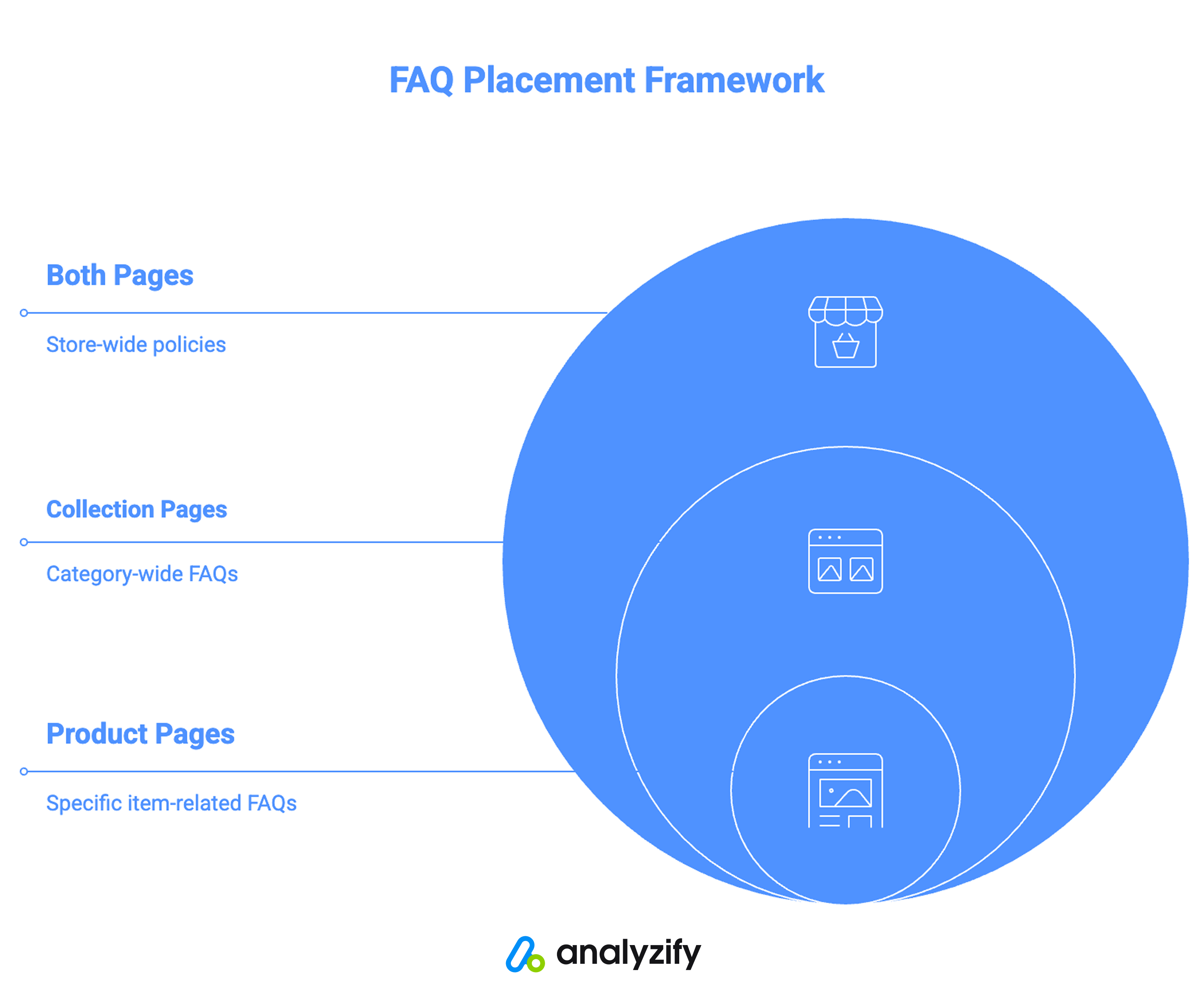
Not every FAQ belongs on every page. Matching the question to the page type is what makes FAQ content useful rather than just present.
Questions that belong on collection pages address the category as a whole and serve users who are still in the research phase:
- Comparisons between product types: “What’s the difference between memory foam and hybrid mattresses?”
- General guidance: “How do I choose the right mattress firmness for my sleep style?”
- Category-wide care or lifespan: “How long do memory foam mattresses typically last?”
- Material or technology explanations: “What is gel-infused memory foam?”
Questions that belong on product pages address the specific item and serve users who are evaluating a particular product:
- Specifications and dimensions
- Compatibility: “Will this fit my adjustable bed frame?”
- Product-specific warranty or care instructions
- Available variations and options
Questions that belong on both are store-wide policies or information that’s relevant at any stage: return windows, shipping timeframes, or care instructions that apply broadly across a collection.
The principle is straightforward: if the question makes sense before a user has chosen a specific product, it belongs on the collection page. If it only makes sense in the context of a specific item, it belongs on the product page.
How to Manage FAQs on Shopify Easily
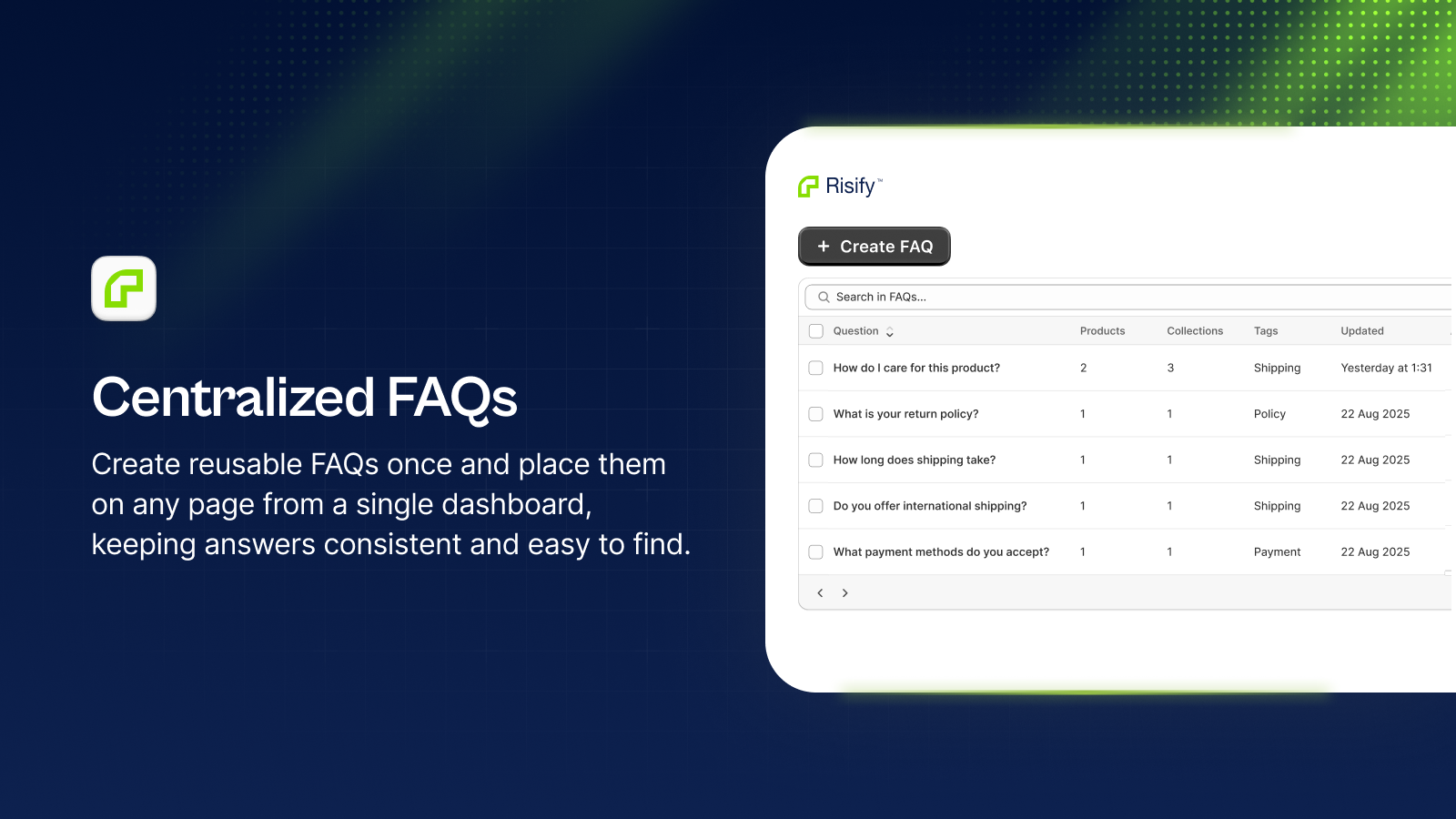
By the time a store has a few dozen products across multiple collections, the page-by-page approach to FAQs has usually already created the inconsistency problems described above or the merchant has avoided the problem by simply not adding FAQs at all.
Risify is built to remove both outcomes.
Central library: create once, assign anywhere
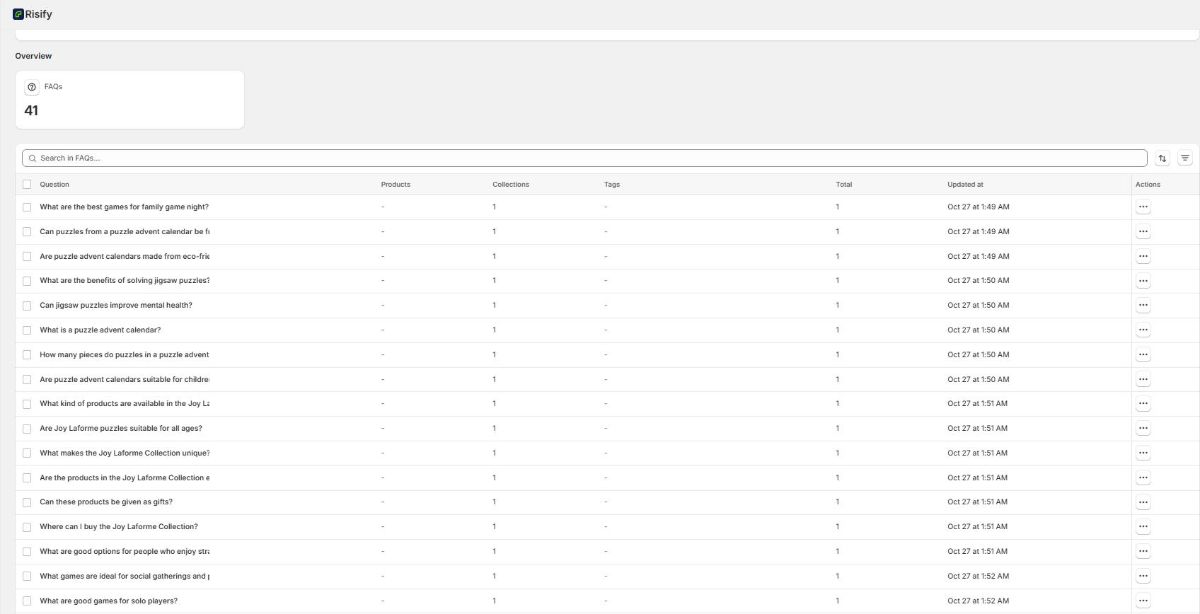
All FAQs in Risify live in a single library. You write the question and answer once. Then you assign that FAQ to any combination of products and collections. One page or fifty, in any mix.
If the answer changes, you update it in the library once and it applies immediately everywhere that FAQ is assigned. No hunting through product pages, no version drift, no inconsistency.
AI generation at scale
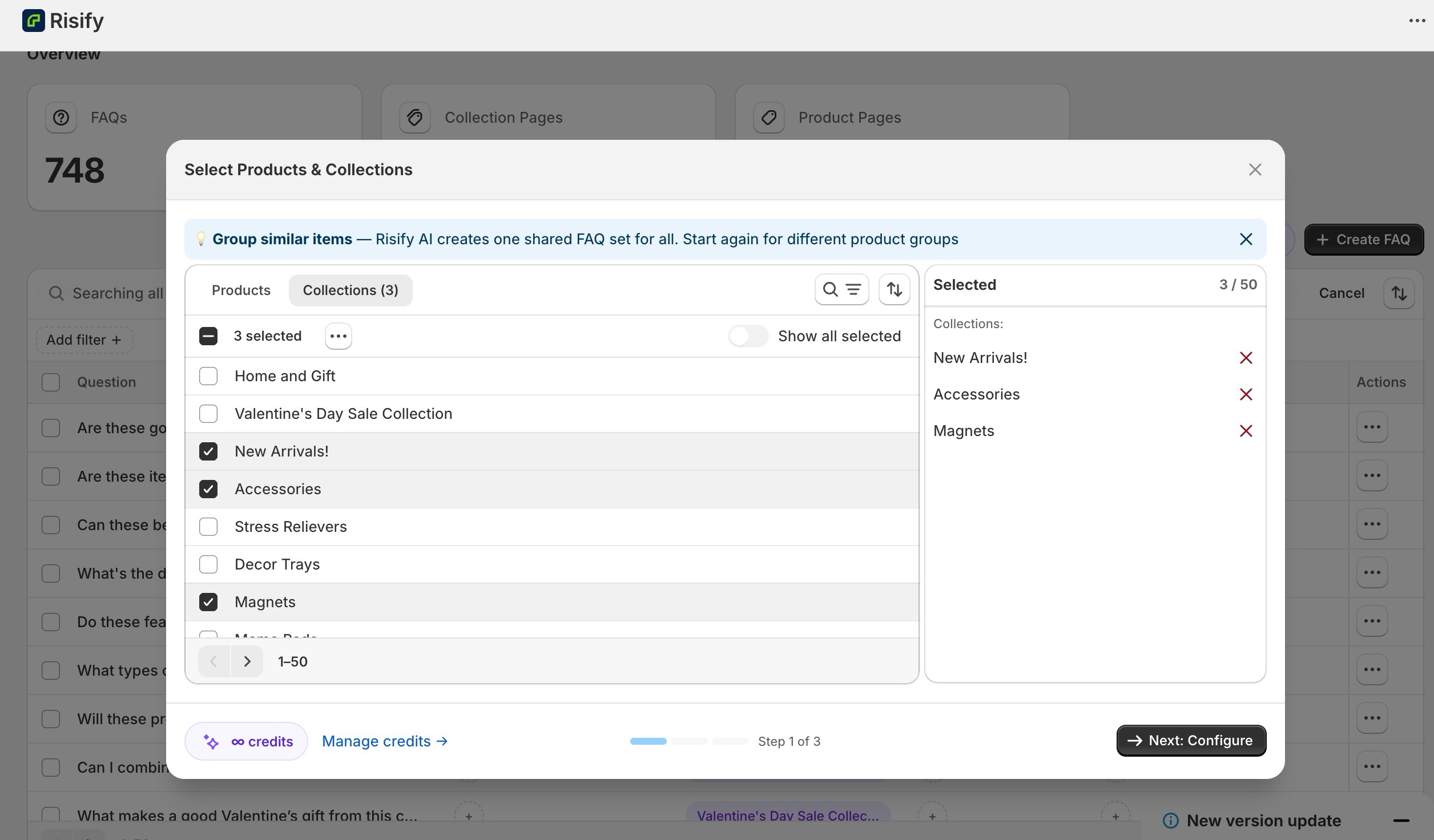
For stores with large catalogs, writing FAQs for every product manually isn’t realistic.
Risify’s AI agent analyzes your products and generates relevant FAQs based on what’s actually on the page.
You review, edit, and publish in bulk rather than writing from scratch. This makes it practical to have proper FAQ coverage across a full catalog without it becoming a weeks-long content project.
Automatic FAQPage schema
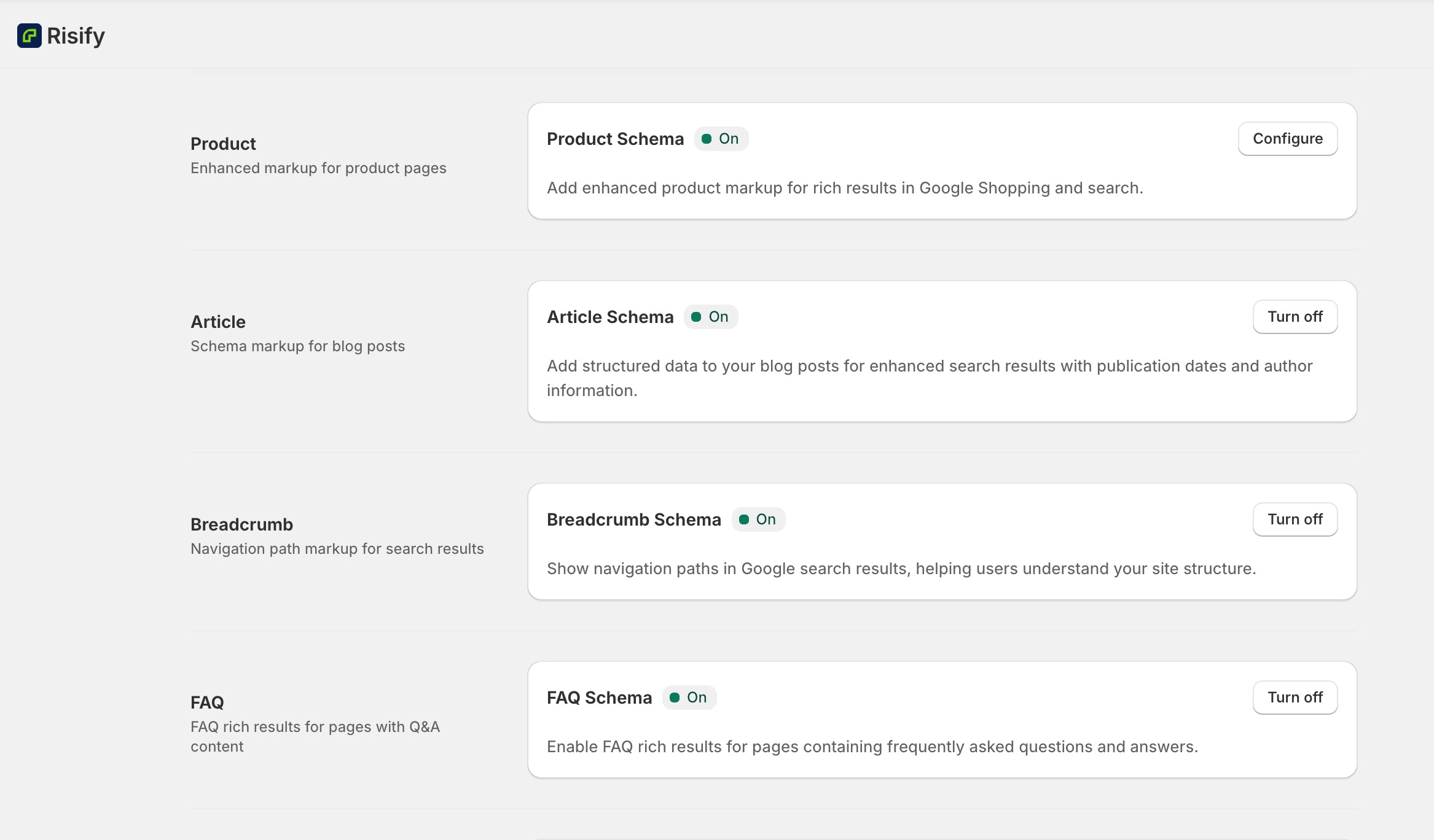
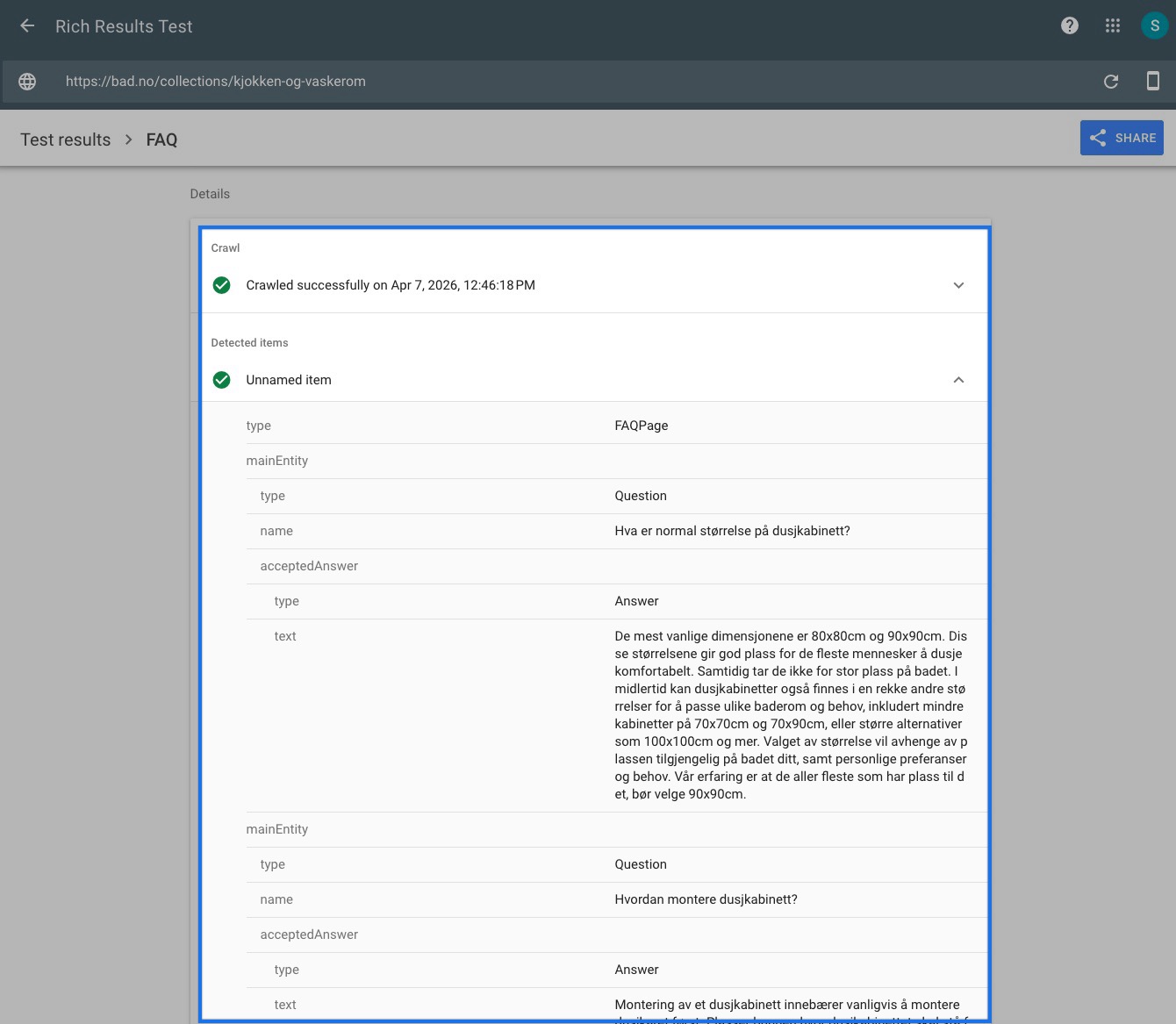
When you create FAQs in Risify and assign them to products or collections, a valid FAQPage schema is generated automatically.
You don’t write JSON-LD, you don’t need to understand schema syntax, and there’s no risk of the markup drifting out of sync with what’s visible on the page because both come from the same source.
The structured data is always accurate because it’s always generated from the same FAQ entry the customer sees.
Collection and product assignment from one place
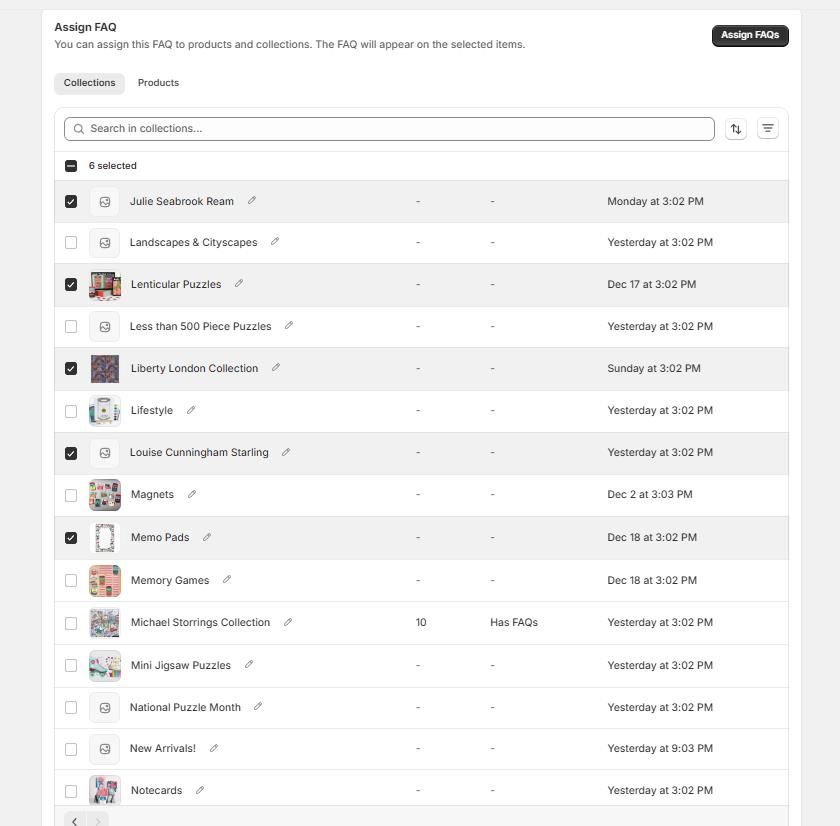
Inside the Risify admin, each FAQ has an assignment panel covering both collections and products.
You decide exactly where each question appears, and you can assign a single FAQ to any combination. The FAQ content stays in one place. Where it appears is entirely controlled by your assignments.
 Get all technical foundations set up for better AI search visibility
Create & Manage FAQ Content Easily
Use Risify's centralized FAQs feature to create & manage your content on both product & collection pages.Conclusion
FAQs done right serve three audiences at once:
- the shopper on the page who has a question before buying,
- the search engine evaluating whether your page answers specific queries,
- AI tool looking for structured content it can extract and reference.
None of those outcomes require different content. They require the same content, properly structured and placed on the right pages.
The barrier for most stores isn’t knowing that FAQs matter. It’s managing them consistently as the catalog grows without turning it into an ongoing maintenance problem. That’s the problem a centralized approach solves.