









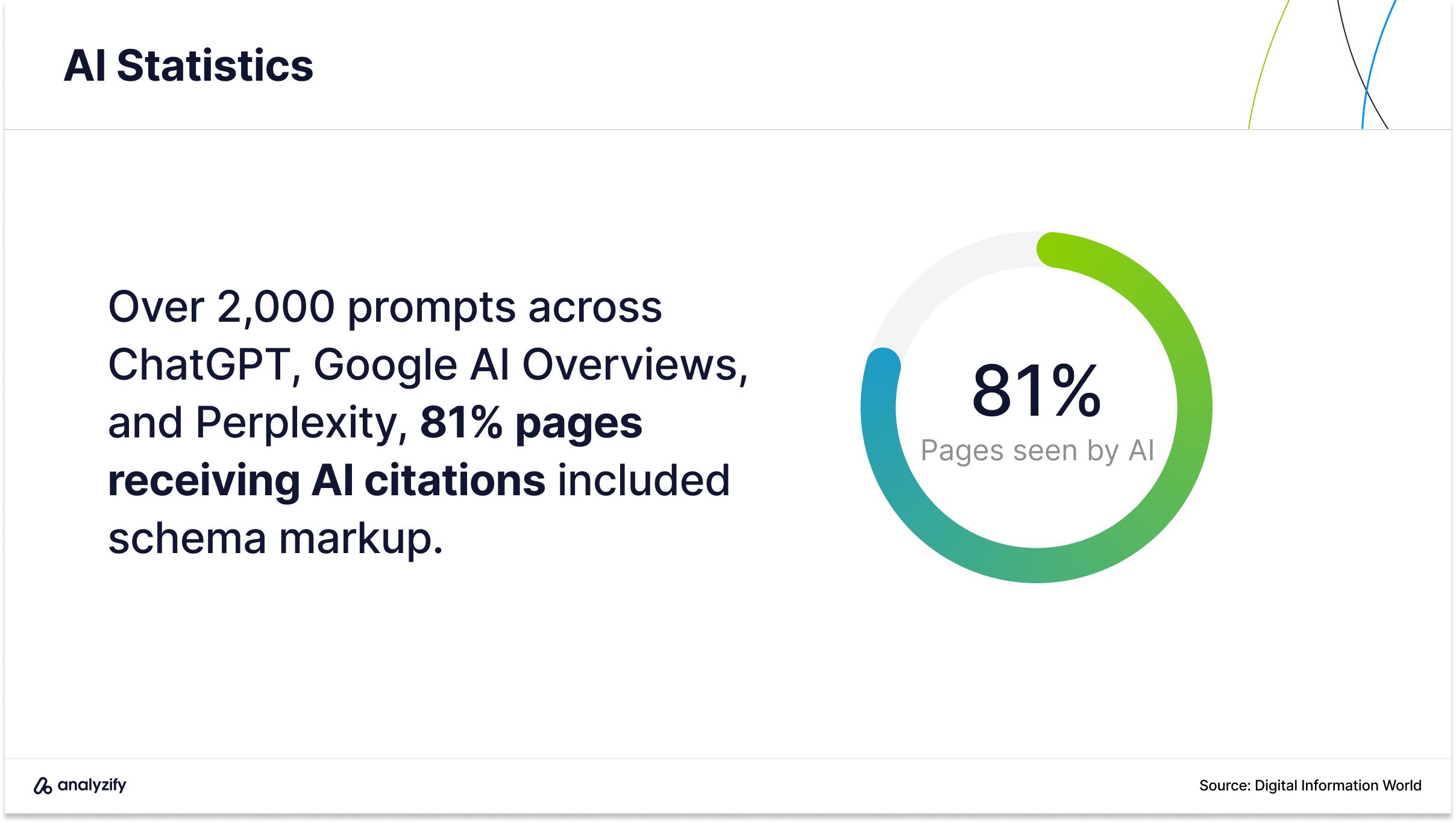
A recent cross-platform study analyzing over 2,000 prompts across ChatGPT, Google AI Overviews, and Perplexity found that 81% pages receiving AI citations included schema markup.
That single figure captures something most merchants haven’t fully absorbed yet:
AI platforms don’t discover content randomly or according to traditional browsing methods. They prefer stores and pages that communicate clearly in a format machines can read.
If your store’s content isn’t structured in a way these platforms can reliably extract, your products may simply not appear in the answers your customers receive.
Structured data is the most direct way to make your Shopify store visible to AI platforms. It’s also something most Shopify stores haven’t fully implemented.
Key takeaways:
- Both Google and Microsoft have publicly confirmed that structured data helps their AI systems understand content more accurately
- Controlled experiments show measurable differences in AI visibility between pages with and without proper schema
- Most Shopify stores lack proper technical foundations out of the box
- The right setup improves how your store appears in AI-driven shopping
Importance of Structured Data for AI Visibility
Search engines have used structured data for years to generate rich snippets: price tags, star ratings, and breadcrumb paths you see in Google results.
But structured data has taken on a second, increasingly important role: it shapes how AI platforms understand and represent your store content.
In March 2025, Microsoft’s Principal Product Manager Fabrice Canel confirmed on stage at SMX Munich that schema markup actively helps Microsoft’s LLMs, including Copilot, understand web content.
At the same time, Google’s structured data engineer Ryan Levering stated at Search Central Live NYC that Google’s systems run significantly better with structured data, and that it’s computationally cheaper for their systems to process than inferring meaning from unstructured text.
Two of the largest AI platforms, in the same month, making the same point independently.
It’s worth being precise about what this means. Structured data gives AI systems a strong, reliable signal but it’s one signal among several.
No single implementation guarantees visibility across every platform. What it does is remove unnecessary friction: instead of an AI tool having to interpret your page, it can simply read what you’ve declared.
How AI Tools Process A Product Page
When an AI tool processes a product page, it attempts to extract meaning in a different way. Without structure, it has to infer which number is the price, whether the item is in stock, and what category the product belongs to.
That inference is imperfect. Structured data removes the guesswork for AI tools.
When an AI platform receives a shopping-related query, it doesn’t browse your store the way a customer does. It parses the underlying code of your pages, extracts what it can, and uses that information to construct an answer.
The challenge here is interpretation. When an AI tool encounters a product description such as:
“Originally $199, now $50. Ships in 3–5 days.”
It has to figure out which number is the current price, which is the original, and what “ships in 3–5 days” implies about availability. It usually gets this right but “usually” is not reliable at scale, across hundreds of product pages with different formats.
With structured data, the AI reads explicit declarations instead of inferring meaning from prose. In other words, when you label your content properly, AI tools like it because it requires less effort to trust.
This extends to every layer of your store: product attributes, category relationships, and FAQ content all benefit from the same principle.
📌 Learn more about what ai systems check in your store’s schema
What’s Included in Structured Data
Structured data covers more than just product prices. A well-implemented schema setup communicates multiple layers of information about your store.
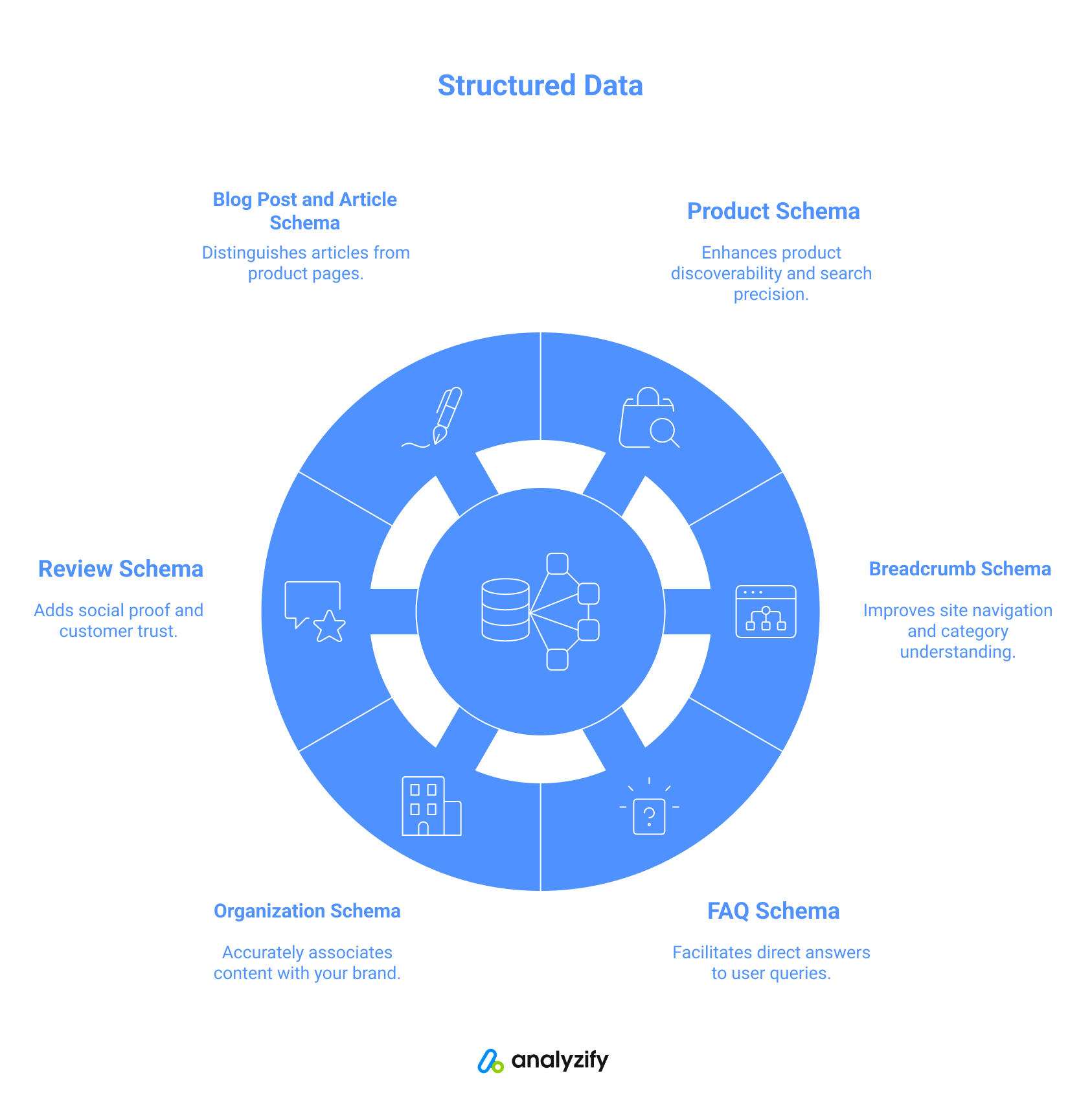
- Product schema declares the specifics of each item you sell: name, price, currency, availability, brand, SKU, and images. These fields allow AI tools and search engines to match your products to relevant queries with precision.
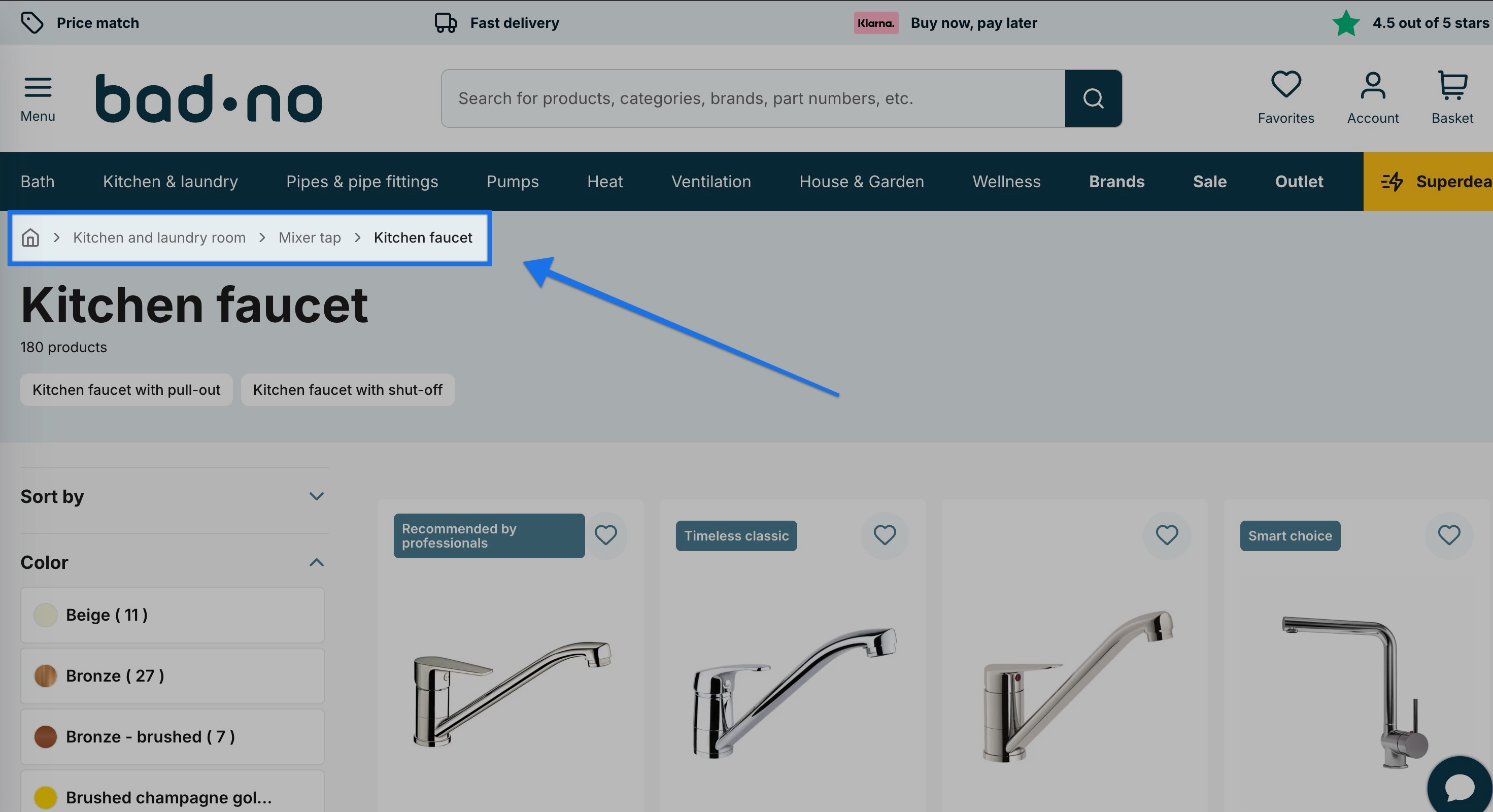
- Breadcrumb schema encodes your site’s navigation hierarchy. For example, Home > Kitchen > Mixer tap > Kitchen faucet. This tells both search engines and AI tools exactly where each page sits within your catalog, helping them understand category relationships rather than infer them from URL patterns alone.
- FAQ schema marks up question-and-answer pairs explicitly. When a user prefers AI search to ask a question that matches one of your FAQs, the AI can surface your answer directly because the schema has already labeled the question and its corresponding response as a pair.
- Organization schema communicates your business identity: your brand name, logo, and contact details, which helps AI tools and search engines associate content with your store accurately.
- Review schema adds social proof signals and marks up ratings and reviews by customers
- Blog post and article schema sends key signals so tools can understand it’s an article, not a product page.
👉🏻 Explore all schema types
The importance of getting the structure right was demonstrated clearly in a controlled experiment published by Search Engine Land: three identical sites were tested with different levels of schema implementation.
The page with well-implemented schema was the only one to appear in AI Overviews and achieved a top-three ranking.
The page with no schema was crawled but never indexed and couldn’t rank at all. Same content, different structure, dramatically different outcomes.
What Structured Data Means for Shopping Queries in LLMs
To understand the practical impact, it helps to look at real evidence rather than hypotheticals.
A product test conducted by Dataslayer compared two listings for the same product from the same brand, one with complete schema including GTIN, real-time pricing, and reviews, the other with only basic schema. Across ten test queries in ChatGPT Shopping, the fully structured product appeared eight times. The basic version appeared twice. Same product, same brand, different data structure.
That result has a clear mechanism behind it. When OpenAI launched ChatGPT’s shopping feature in April 2025, the company confirmed that the system considers structured metadata, including price and product descriptions, when determining which products to recommend. The schema isn’t just a formatting preference. It’s part of how the platform decides what to surface.
BrightEdge’s 16-month citation study adds further context at scale: pages with robust structured data consistently showed higher citation rates in Google AI Overviews over the study period. AI visibility isn’t binary. Better-structured pages get referenced more reliably and more often.
The Function of Schema in AI Shopping Searches
Now let’s look at how AI tools actually handle shopping queries to better understand the situation:
A user asks: “What kitchen sinks are available for under $100?” The AI tool processes product pages from multiple stores, attempting to extract names, prices, and availability.
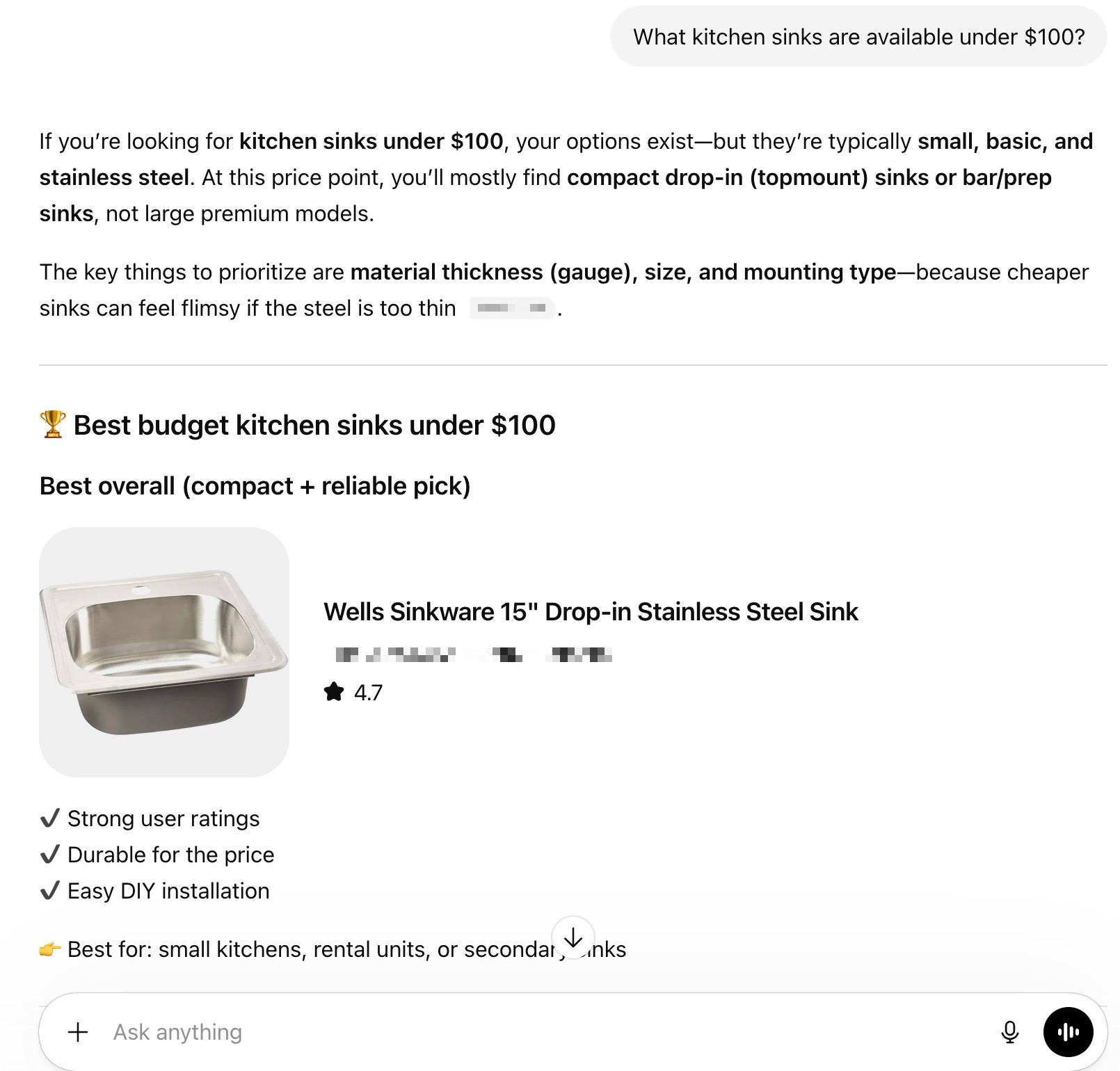
For pages with Product schema in place, this is straightforward: price and availability are explicitly labeled fields. For pages without it, the AI must parse unstructured text, which produces less reliable results.
The store with clean schema is more likely to be represented accurately in the AI’s response. The store without it may be misrepresented or missed entirely.
FAQ schema creates a similar advantage for informational queries. If a user asks “How to install a kitchen faucet?” and your store has that question marked up with FAQPage schema, an AI tool can match the user’s question directly to your answer.
Without schema, the AI would have to extract relevant sentences from a block of text, a less precise process that may not surface your content at all.
Breadcrumb schema adds another dimension: it helps AI tools understand the context of a product. Knowing that a kitchen faucet belongs under Kitchen > Mixer tap > Kitchen faucet rather than being a standalone item helps the AI categorize and present results more accurately when users browse by category or room type.
How to Make Your Shopify Store Visible to AI Tools
The challenge for most Shopify merchants is that solid schema implementation doesn’t come out of the box.
Default Shopify themes include some basic structured data, but coverage is typically incomplete. Breadcrumbs may be missing. FAQs are rarely marked up. Organization and review schema often require custom development.
That means the majority of Shopify stores are leaving AI visibility on the table because their pages aren’t formatted in a way AI tools can consistently extract & understand.
Fixing this manually requires either technical knowledge or developer resources. Editing JSON-LD schema files, validating markup, and keeping it updated across hundreds of product and collection pages is a meaningful operational burden.
This is where Risify comes in to simplify the process.
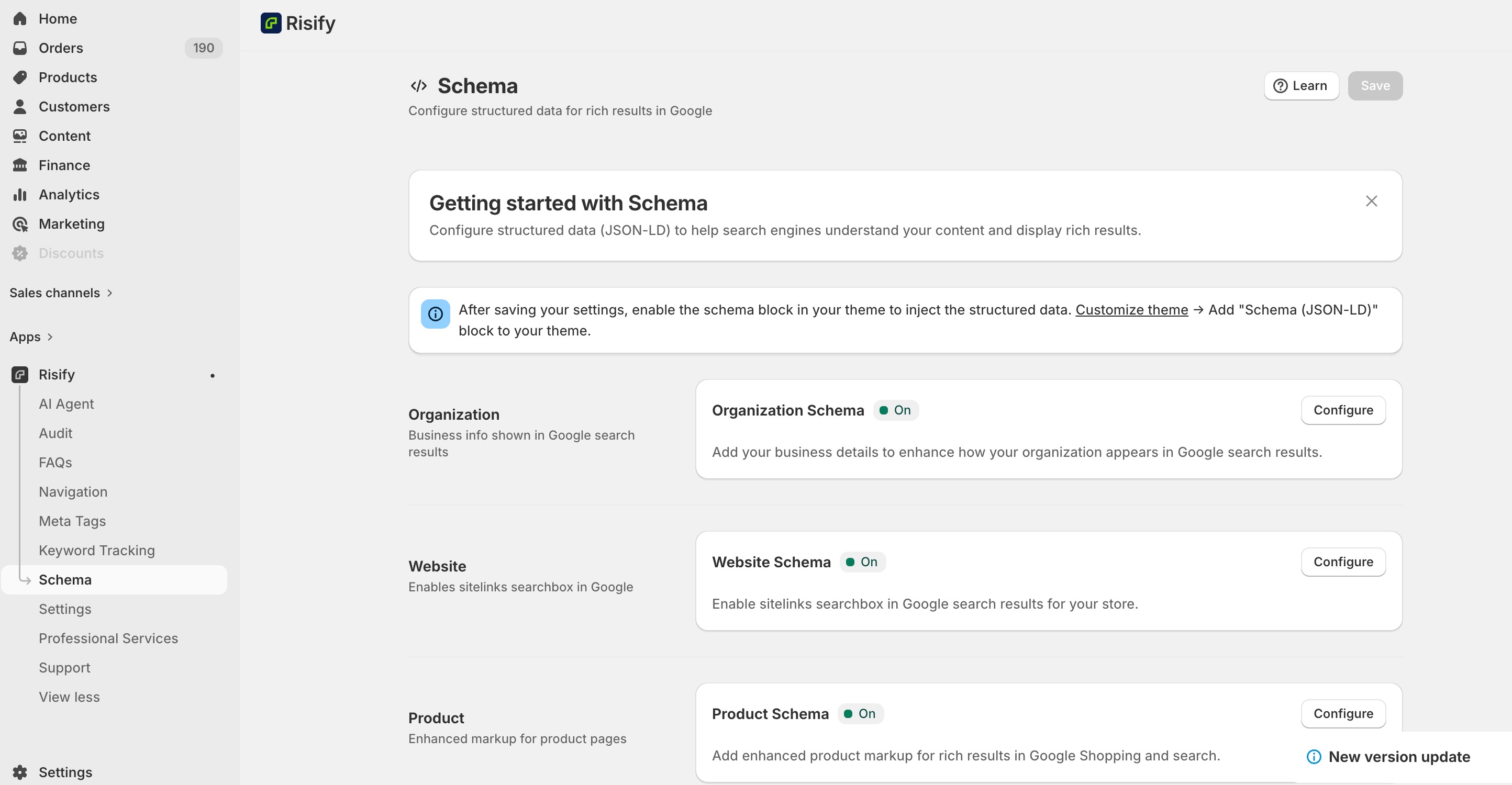
Rather than requiring custom development for each schema type, you can use Risify to generate Product, Breadcrumb, FAQ, Organization, Review, and Blog Post schema automatically as you configure your store.
You define your navigation paths and assign FAQs to products and Risify handles the structured data output. The result is a consistent, valid schema across your store within a single app.
 Built for Organic Growth and AI Visibility
Structure Your Data Easily
Set up your schema in minutes and improve your store's AI visibility. No technical expertise needed.Improve Your Product Discovery in AI Platforms
The shift toward AI-mediated discovery is already underway. As mentioned, Microsoft has confirmed that structured data feeds its LLMs. Google’s systems favor it because it’s easier to process. Independent experiments show measurable visibility differences between pages that implement schema and those that don’t.
For Shopify merchants, this creates a window. Most stores have not adapted to this reality. Structured data is still treated as an SEO edge case rather than a fundamental part of how a store communicates with the web.
Your store has valuable products, useful answers, and a clear structure in your head. The question is whether that structure is visible to the tools that are increasingly deciding what customers find.
Risify is built specifically for Shopify stores trying to achieve exactly this. Its Claude integration adds another layer of intelligence to the process: using AI to help optimize how your store’s content is structured and communicated to the AI tools your customers are already using.
Get all technical foundations set up for better AI search visibility
Risify improves product discovery with clear navigation, centralized FAQs, and smart suggestions, making your store easier for AI tools like ChatGPT and Gemini to understand.

- Navigation and internal linking
- Reusable FAQs and structured content
- Valid schema markup for AI and search visibility
- AI-powered FAQ and metadata generation
- Store audits to see exactly what to fix