









Over the past year, multiple research teams have independently tested this question to find an answer that makes sense:
Does schema markup actually help your pages get cited by AI tools?
Their findings, published between late 2025 and mid-2026, cover platforms like Google AI Overviews, ChatGPT, Perplexity, and Gemini.
This post walks through each study, what it measured, what it found, and what it all means for your Shopify store.
Key takeaways:
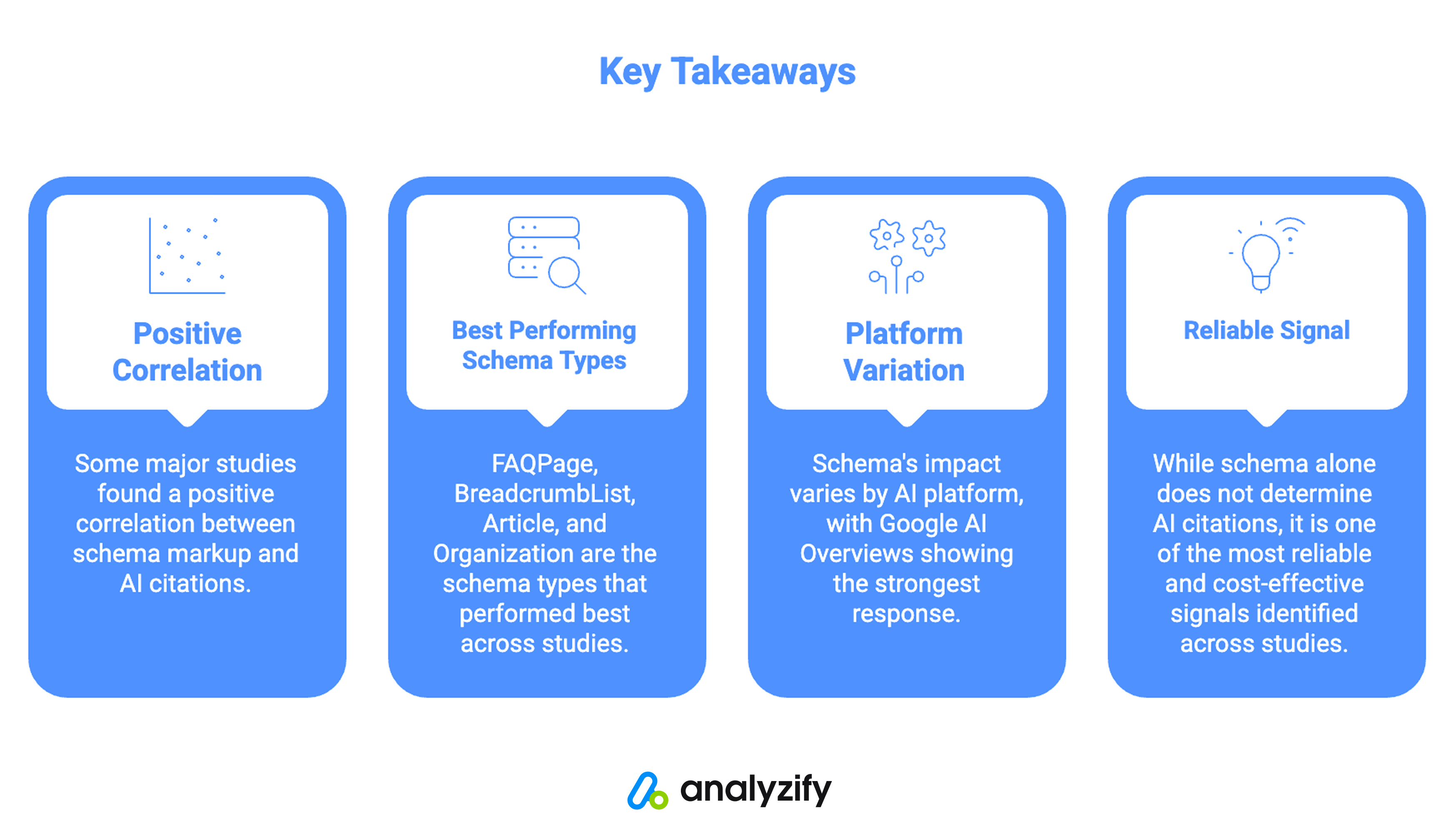
- Some major studies found a positive correlation between schema markup and AI citations
- The schema types that performed best across studies are FAQPage, BreadcrumbList, Article, and Organization
- Schema’s impact varies by AI platform, with Google AI Overviews showing the strongest response
- While schema alone does not determine AI citations, it is one of the most reliable and cost-effective signals identified across studies
Study Findings: Does Schema Markup Improve AI Citations?
Here are the conclusions that independent studies, each with different methodologies and sample sizes, reached.
16,851 Queries Across ChatGPT by AirOps
AirOps partnered with Kevin Indig to analyze 16,851 queries and 353,799 pages across ChatGPT’s retrieval pipeline.
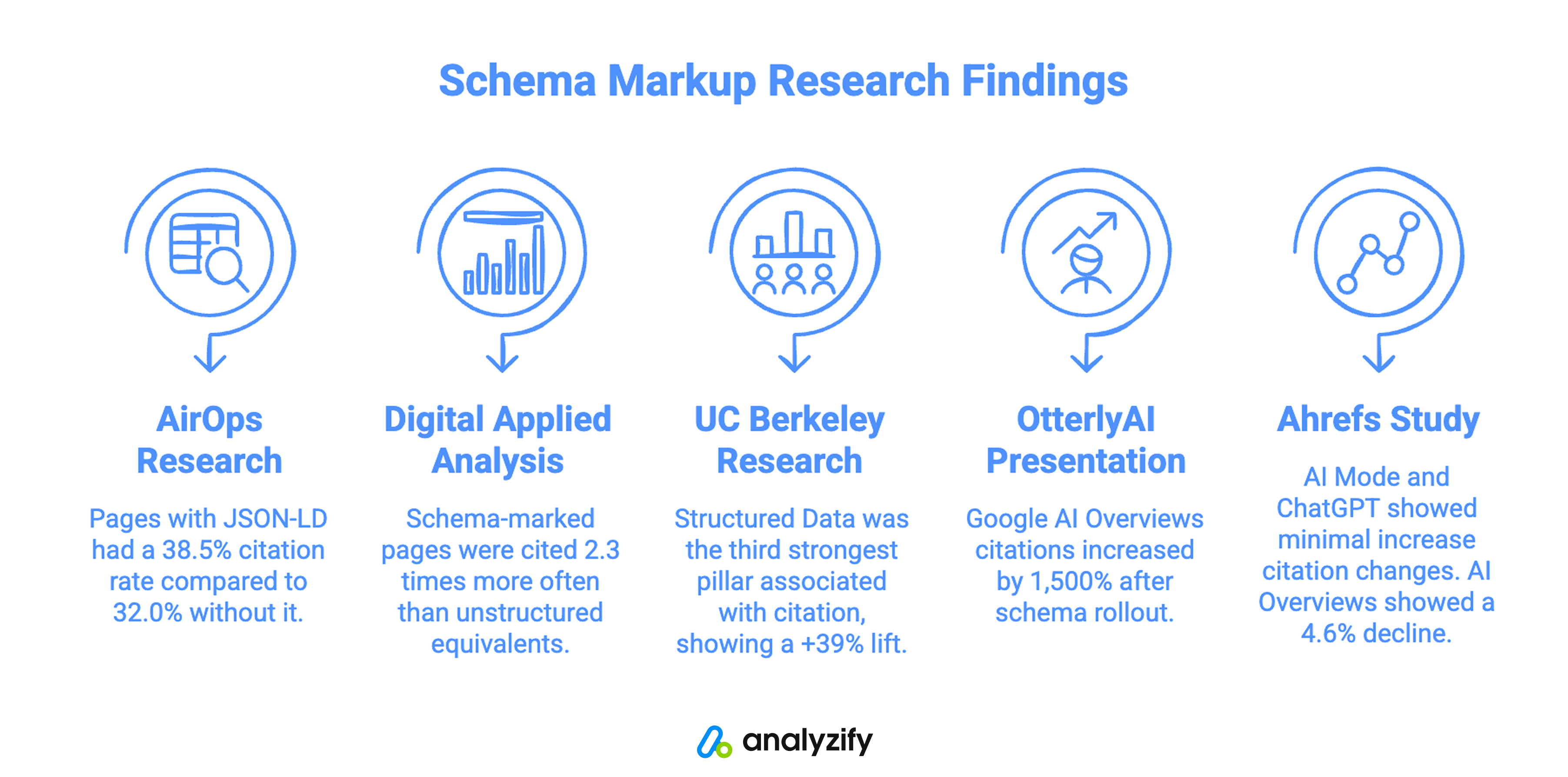
Pages with JSON-LD had a 38.5% citation rate compared to 32.0% without it, a 6.5 percentage point advantage.
The top-performing schema types were BreadcrumbList (46.2%), FAQPage (45.6%), and Organization (44.3%).
The researchers controlled for word count, headings, domain authority, and query match. JSON-LD pages scored similarly on all of those signals, suggesting the schema advantage is independent rather than a byproduct of other quality indicators.
1,000 Google AI Overviews by Digital Applied
Digital Applied analyzed 1,000 AI Overviews across 10 query intents, comparing 4,243 cited URLs against approximately 50,000 non-cited controls.
Schema-marked pages were cited 2.3 times more often than unstructured equivalents. When the HowTo schema was added to procedural content, the multiplier reached 2.8 times.
The researchers called schema “the single biggest page-level lever in the dataset” and recommended it as a first-priority action.
Notably, three signals most SEOs typically optimize for (page recency, load speed, and reading-grade level) did not correlate with citation rate.
1,702 Citations Across Three AI Engines by UC Berkeley
A research paper from UC Berkeley introduced the GEO-16 framework, auditing 1,100 unique URLs across 1,702 citations from Brave, Google AIO, and Perplexity.
Structured Data was the third strongest pillar associated with citation, showing a +39% lift. It followed Metadata and Freshness (+47%) and Semantic HTML (+42%).
As an academic study, this carries particular weight. It was produced by researchers measuring what actually predicts AI citations, not by a company with a product to promote.
2,000+ URLs Tested Sitewide by OtterlyAI
At BrightonSEO in April 2026, OtterlyAI presented results from a sitewide schema rollout across 2,000+ URLs.
Google AI Overviews citations increased by 1,500%. AI Mode increased by 377%. However, citations dropped on ChatGPT, Gemini, and Copilot. Perplexity showed no impact.
This highlights one of the most important nuances in the research: schema’s effect is not uniform across platforms. Google’s ecosystem responds strongly. Other AI tools do not appear to weight it the same way.
1,885 Pages Tracked Over 7 Months by Ahrefs
Ahrefs tracked 1,885 pages that added JSON-LD between August 2025 and March 2026, matched against 4,000 control pages, measuring citation changes across Google AI Overviews, AI Mode, and ChatGPT.
The results: AI Mode showed +2.4% and ChatGPT showed +2.2%, both statistically indistinguishable from zero. AI Overviews showed a small 4.6% decline, statistically significant but too small to attribute clearly to schema.
The methodology was rigorous. Four separate tests all pointed the same direction: schema didn’t move the needle.
But Ahrefs themselves flag an important caveat.
Every page in their dataset already had 100+ AI Overview citations before schema was added. These were pages already inside the AI consideration set.
Their conclusion: “If a page is already getting picked up, our data suggests that adding schema isn’t going to push it higher. But for pages that aren’t being seen by AI systems at all, schema markup might still play a role.”
For most Shopify stores, the challenge is not improving citations on pages AI already knows about. It is getting discovered in the first place.
What This Means for Your Shopify Store
The research paints a clear picture when viewed collectively.
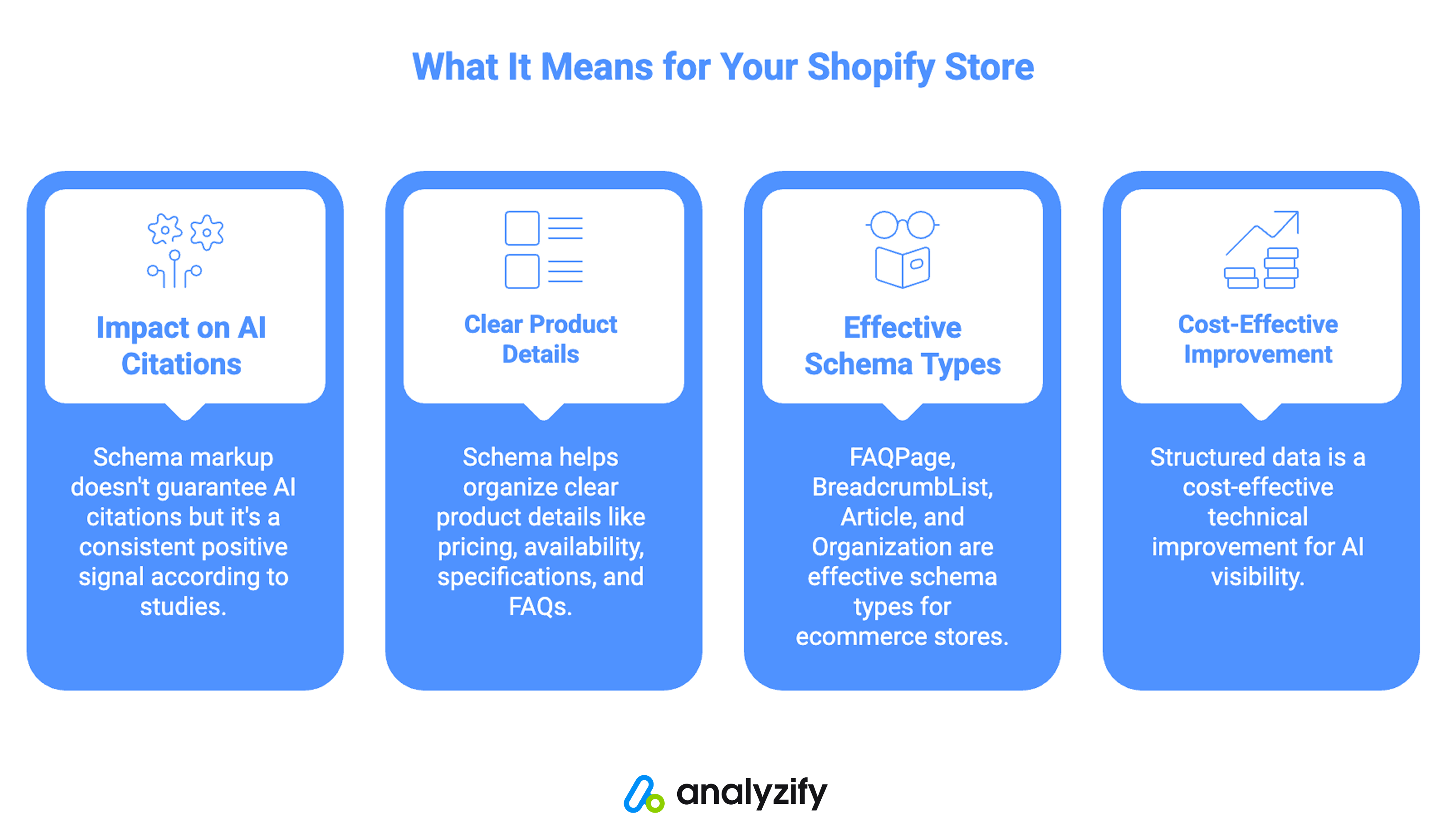
Schema markup might not be a guarantee of AI citations. But it is a consistent, positive signal identified by multiple independent research teams across different methodologies and platforms.
For Shopify stores, three things stand out.
First, most Shopify stores are not already being cited by AI tools, which means they’re in a different starting position than the pages Ahrefs studied.
The Ahrefs dataset focused on pages that were already inside the AI consideration set with 100+ citations.
For stores that haven’t reached that baseline yet, the broader research suggests schema can play a role in initial discoverability.
To understand why, consider what happens when a customer asks an AI tool “What’s the best 55-inch smart TV under $500?” The AI scans product pages for structured details like screen size, resolution, smart TV support, operating system, pricing, and availability.
If that information is not marked up with schema, the AI has to interpret unstructured text, and the research consistently shows it does that less reliably.
Most Shopify stores have gaps in exactly these areas:
- Incomplete product specifications that AI tools cannot parse accurately
- Missing availability and pricing data in a structured format
- No FAQ content on product or collection pages
- Unanswered customer questions that AI tools are actively searching for
This is consistent with what Google and Microsoft have stated publicly: structured data reduces the need for their AI systems to infer meaning from unstructured pages.
The best-performing schema types match ecommerce needs. The schema types that correlated most strongly with AI citations across these studies (FAQPage, BreadcrumbList, Article, and Organization) are precisely the types Shopify stores benefit from most.
They represent your catalog hierarchy, Q&A content, blog posts, and brand identity.
Schema is a cost-effective structural lever. Multiple researchers describe it this way.
It requires correct implementation and ongoing accuracy, which Risify handles for Shopify stores without code or development work.
Structured data is not the only thing that matters for AI visibility, but it is one of the most reliable foundations you can put in place.
Conclusion
The research shows that schema markup will not single-handedly get your store recommended by AI tools.
But it also shows that schema makes your pages easier for AI systems to read, categorize, and cite.
Across independent studies, that signal showed up consistently. For Shopify merchants, the practical takeaway is straightforward.
Check what schema your store currently has, identify the gaps, and fix them.
The research suggests it is one of the most cost-effective structural improvements you can make.