










Research across more than 2,000 prompts on ChatGPT, Google, and Perplexity found that 81% of pages receiving AI citations had structured data in place.
Both Google and Microsoft have publicly confirmed that structured data helps their AI systems process web content more accurately.
Breadcrumb schema markup is one specific (and frequently overlooked) layer of that structured data foundation.
Without breadcrumb schema, search engines and AI platforms are missing something equally important: where your products fit within your catalog.
Which category they belong to. How that category relates to broader ones. The hierarchy that gives your store’s content structure and context.
Let’s explore what BreadcrumbList schema markup communicates, Shopify’s limitations, and what consistent breadcrumb schema can change for both search engines and AI tools.
Key takeaways:
- Breadcrumb schema communicates catalog hierarchy explicitly to both search engines and AI tools
- Without it, platforms either infer your store’s structure from unreliable signals or miss it entirely
- Flat collection system and history-based breadcrumbs make consistent schema difficult to achieve by default
- Complete, consistent BreadcrumbList schema improves how your store is interpreted for both category-level search queries and AI product recommendations
How Search Engines and AI Tools Understand Your Catalog
To explore how correct breadcrumbs and breadcrumbList schema help your AI visibility, we should first focus on how search engines and ai tools understand your catalog.
When Google crawls your store or an AI tool processes your pages, both are doing the same fundamental thing: trying to understand what your content means and how it’s organized.
Product schema helps with individual items. It tells platforms what a product is, what it costs, and whether it’s available.
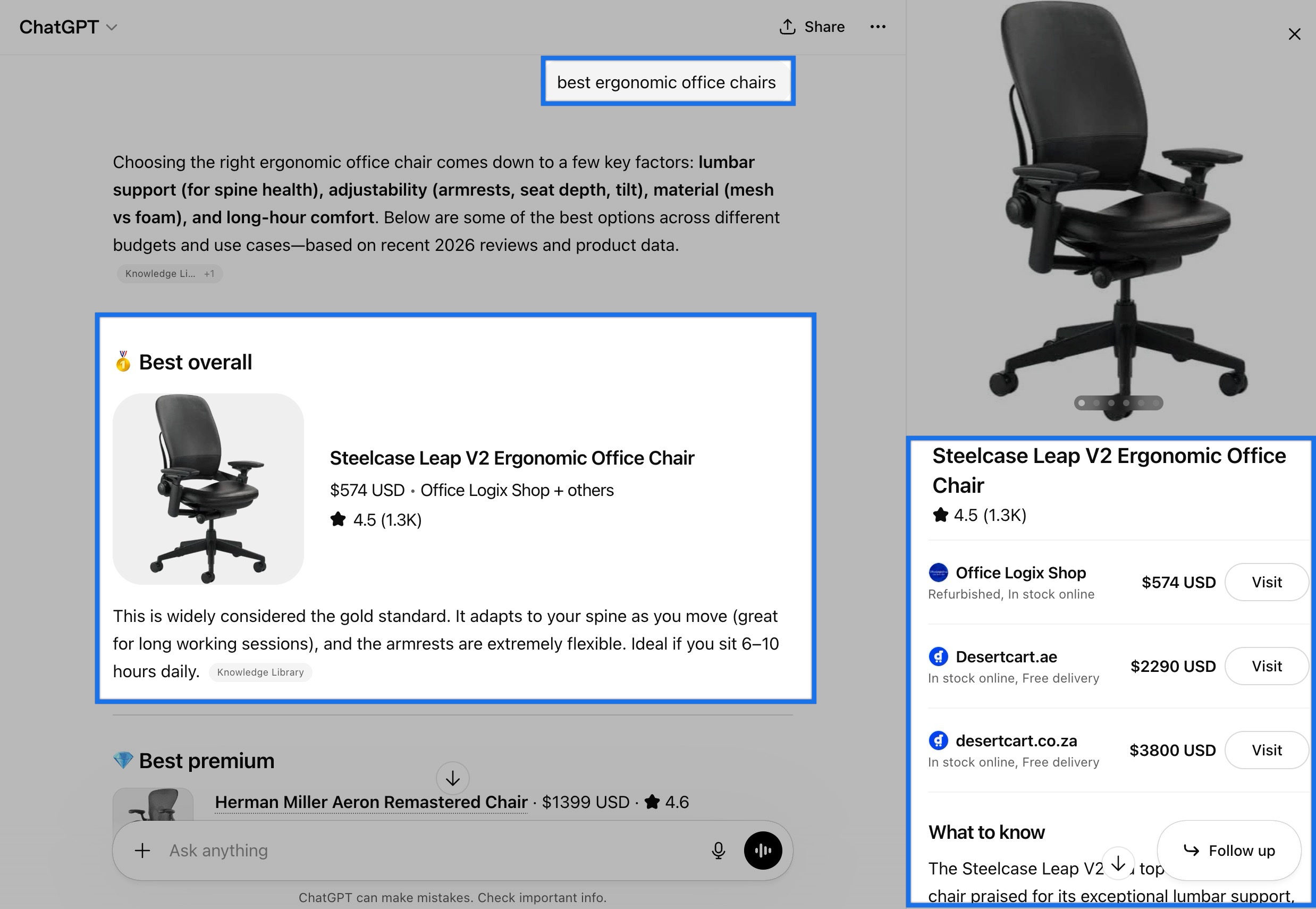
But that’s item-level information. For category-level queries like “best ergonomic office chairs,” “cast iron cookware,” “trail running shoes” platforms need a different kind of signal.
They need to understand how your products relate to categories, and how those categories relate to each other.
This is where BreadcrumbList schema markup becomes helpful.
A user asks Google or an AI tool for the best ergonomic office chairs is actually searching within a category.
Platforms responding to that query need to understand which pages on your store belong to that category and that understanding depends on hierarchy signals.
BreadcrumbList schema provides those signals explicitly.
It tells search engines and AI tools: this product belongs to Ergonomic Chairs, which is a subset of Office Chairs, which falls under Home Office Furniture.
That chain of relationships is declared directly in structured data rather than implied through URL patterns or navigation menus.
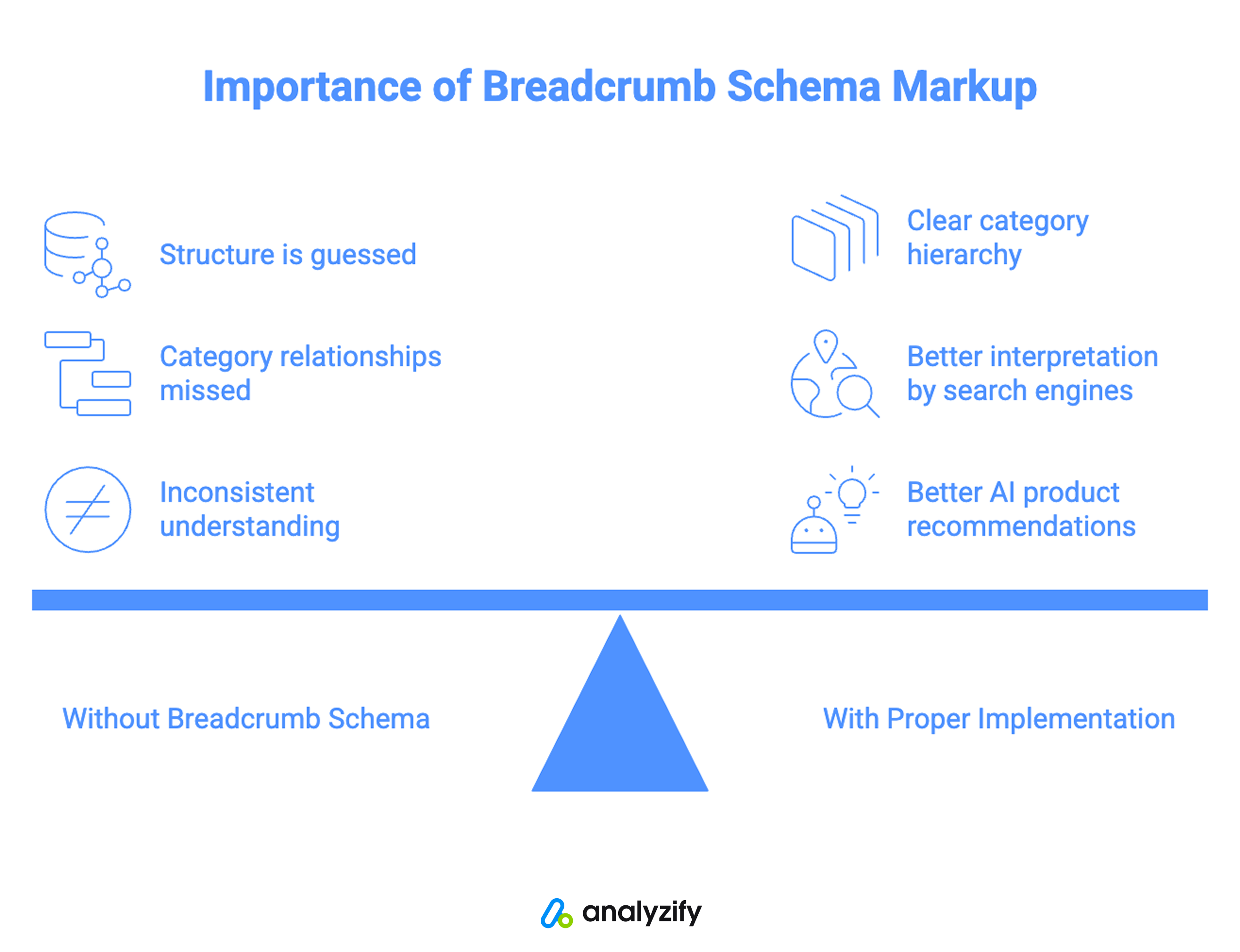
Without it, platforms have two options: infer the structure from surrounding context, which is unreliable across different page formats, or treat your product and collection pages as disconnected entities with no meaningful relationship to each other.
Neither outcome serves your store well in search results or in AI-generated recommendations.
Learn more about structured data’s impact on your Shopify store’s AI visibility.
What Breadcrumb Schema Markup Communicates
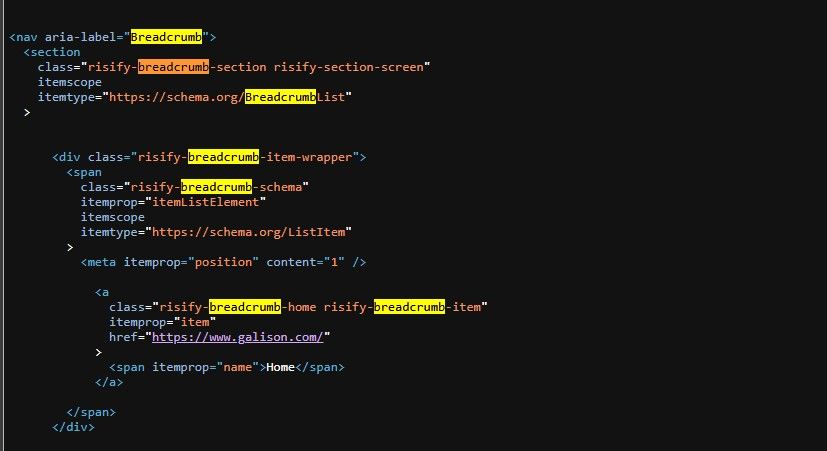
BreadcrumbList schema is structured data markup that encodes your page’s position within your site hierarchy.
It declares each level of the path as an explicit item, with a name and a URL, in a sequence that AI tools and search engines can read and interpret.
For a product page in a home office store, a well-structured breadcrumb path might look like:
Home > Home Office > Desks > Standing Desks > Electric Standing Desks
Each level in that path is a declared relationship.
The schema tells search engines and AI tools that Electric Standing Desks is a subset of Standing Desks, which belongs under Desks, which is part of Home Office. The hierarchy is stated.
Compare that to a store where no breadcrumb schema is defined.
The same product exists. The same collections exist. But to a search engine or AI tool processing the page, those five levels appear as disconnected pages with no defined relationship to each other. The product lives somewhere in the catalog, but where exactly is unclear.
The difference matters for two specific reasons:
Defined hierarchy strengthens topical relevance signals. A store that explicitly communicates depth across Home Office > Desks > Standing Desks > Electric Standing Desks signals organized, in-depth coverage of that product cluster. Google uses this to evaluate relevance for queries across the whole topic area, not just the specific product page. Internal links between pages with defined hierarchical relationships also carry more structural meaning than links between disconnected flat pages.
The hierarchy chain helps with accurate category-level matching. An AI tool like ChatGPT or Google Gemini answering “what are the best electric standing desks for home offices?” needs to understand which pages on your store are relevant to that query.
Correct BreadcrumbList schema makes that matching reliable. Without it, the AI is reading page text and drawing inferences, a process that works inconsistently across different page layouts and writing styles.
One important technical note: schema that contradicts visible page content gets discarded entirely.
If the breadcrumb displayed to visitors shows one path and the schema declares a different one, platforms treat the markup as unreliable and ignore it.
So, accuracy between the two is as important as having the schema in place.
Exploring Default Breadcrumbs in Shopify
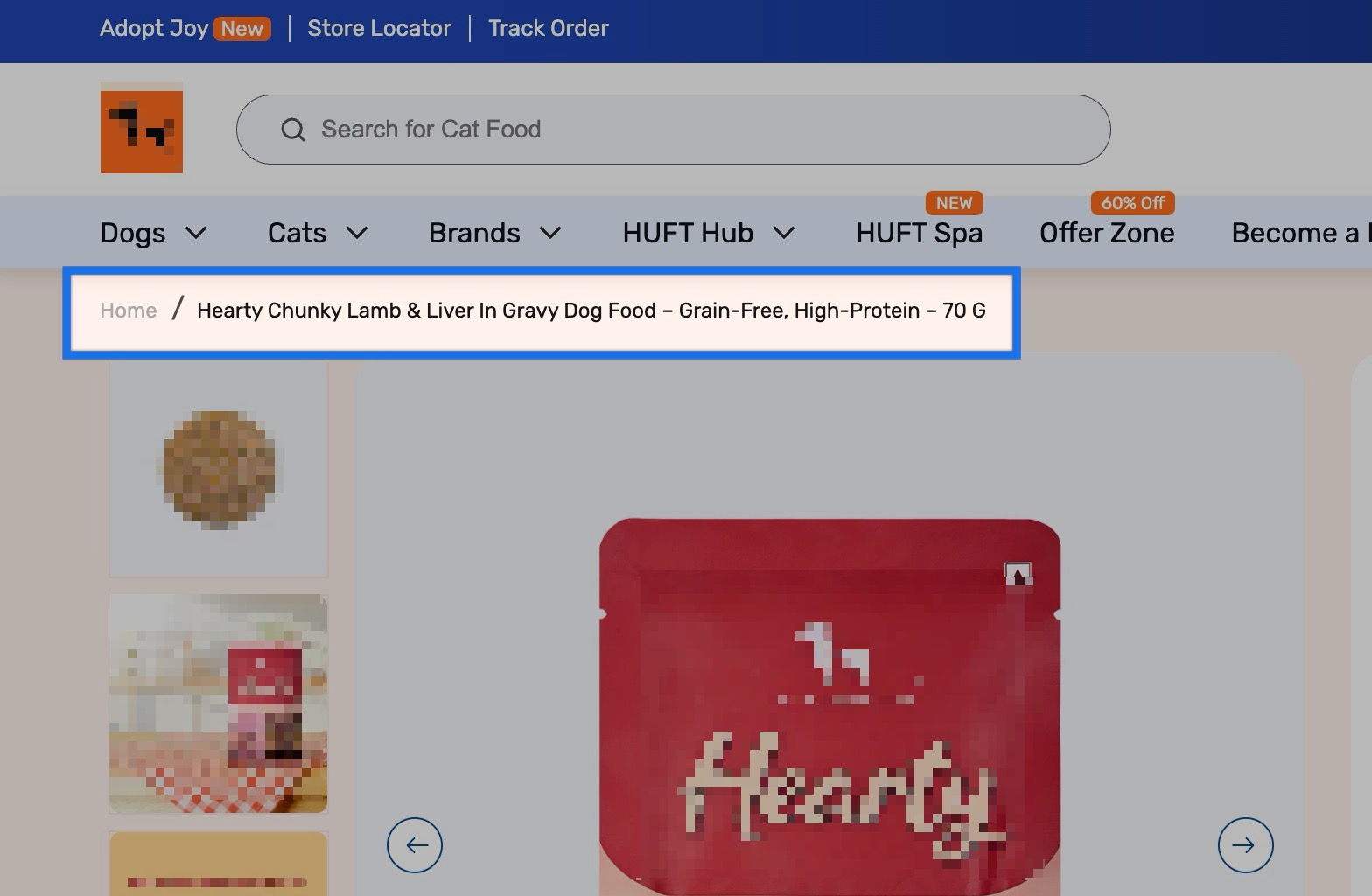
Shopify’s breadcrumb limitations create a specific structural problem that affects both search and AI visibility for stores:
The Flat Collection System
Shopify stores all collections at the same level in its database.
There is no native parent-child relationship between collections. Home Office, Desks, Standing Desks, and Electric Standing Desks are stored as four independent entities with no defined connection to each other.
The navigation menu you build might create the visual appearance of hierarchy for visitors, but that nesting exists only on the front end. It communicates nothing to search engines or AI tools.
This means the hierarchy you see in your store doesn’t exist in your data.
Without explicitly defining and outputting those relationships as structured data, Google and AI platforms see a flat list of disconnected collection pages, not the organized catalog you intended.
History-Based Breadcrumbs
Most Shopify themes generate breadcrumbs based on how a visitor arrives.
A shopper who clicks through a collection to a product gets a breadcrumb reflecting that path. The same product accessed directly (from a Google search, a paid ad, or a shared link) gets a different breadcrumb or none at all.
For AI visibility, this inconsistency is particularly damaging.
AI tools crawling your store encounter different schema on the same page depending on entry point, or find no schema at all on direct product URLs.
Inconsistent schema gets treated the same way as inaccurate schema: platforms discard it and fall back to interpreting your unstructured page content.
The pages most likely to have this problem are your best-ranking product pages. Google indexes and links to canonical product URLs, the direct URLs without collection context.
Those are exactly the pages where history-based breadcrumbs fail to render correctly, which means the pages receiving the most organic traffic are the ones with the weakest or most unreliable hierarchy signals.
What Correct Breadcrumb Schema Markup Changes for AI Visibility
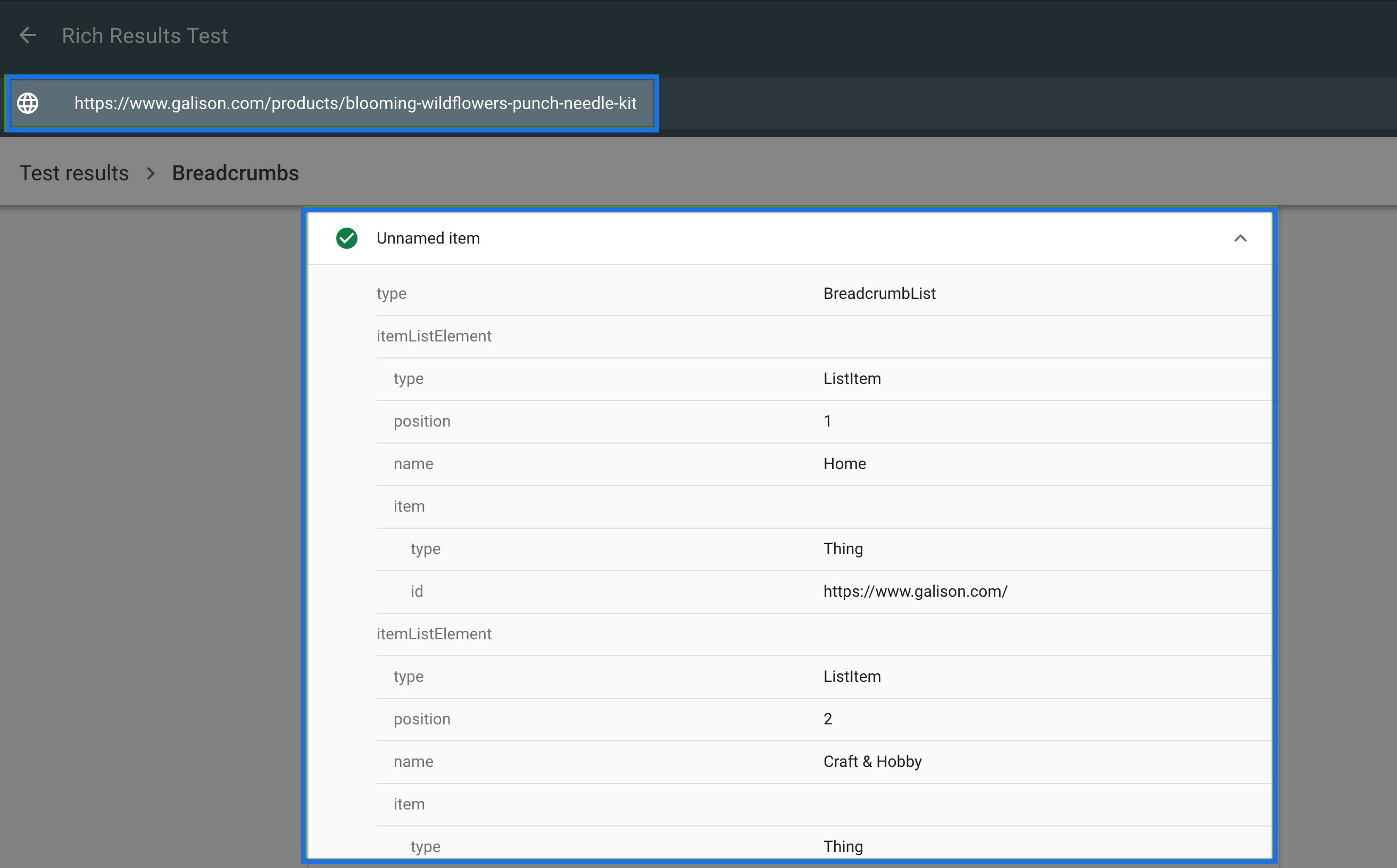
When you set up proper breadcrumbs along with BreadcrumbList schema, both search engines and AI tools have a reliable map of your catalog hierarchy.
The practical impact is most visible at the category level. Consider a kitchenware store with a collection structure like:
Home > Cookware > Pots & Pans > Cast Iron > Cast Iron Skillets
A user asks an AI tool: “What’s the best cast iron skillet for a beginner?” The AI processes product pages from multiple stores.
For stores with complete BreadcrumbList schema across this hierarchy, the AI can confirm: this product is explicitly categorized under Cast Iron Skillets, which belongs to Cast Iron, which is part of Cookware. The category match is reliable.
For stores without schema, or with inconsistent schema, the AI must infer the same relationship from product descriptions, page titles, and surrounding text.
That inference is less reliable, particularly when product descriptions use varied language or when the same product appears in multiple collections with no defined primary hierarchy.
The depth of the hierarchy also matters. A store that explicitly communicates five levels of category structure signals more organized, topically coherent coverage of cookware than a store where the same products appear as flat, disconnected pages.
That depth influences both how search engines evaluate topical relevance and how AI tools assess which stores are most authoritative sources for a given product category.
This is the same principle behind the broader structured data argument: explicit signals produce more reliable outcomes than inferred ones. Breadcrumb schema is how that principle applies to catalog hierarchy specifically.
How to Add Breadcrumb Schema for Your Shopify Store
Risify is built to solve exactly the two problems that you’ve just learned about, without requiring any technical knowledge.
Here’s what Risify gives your store:
A Defined Breadcrumb Path for Every Page
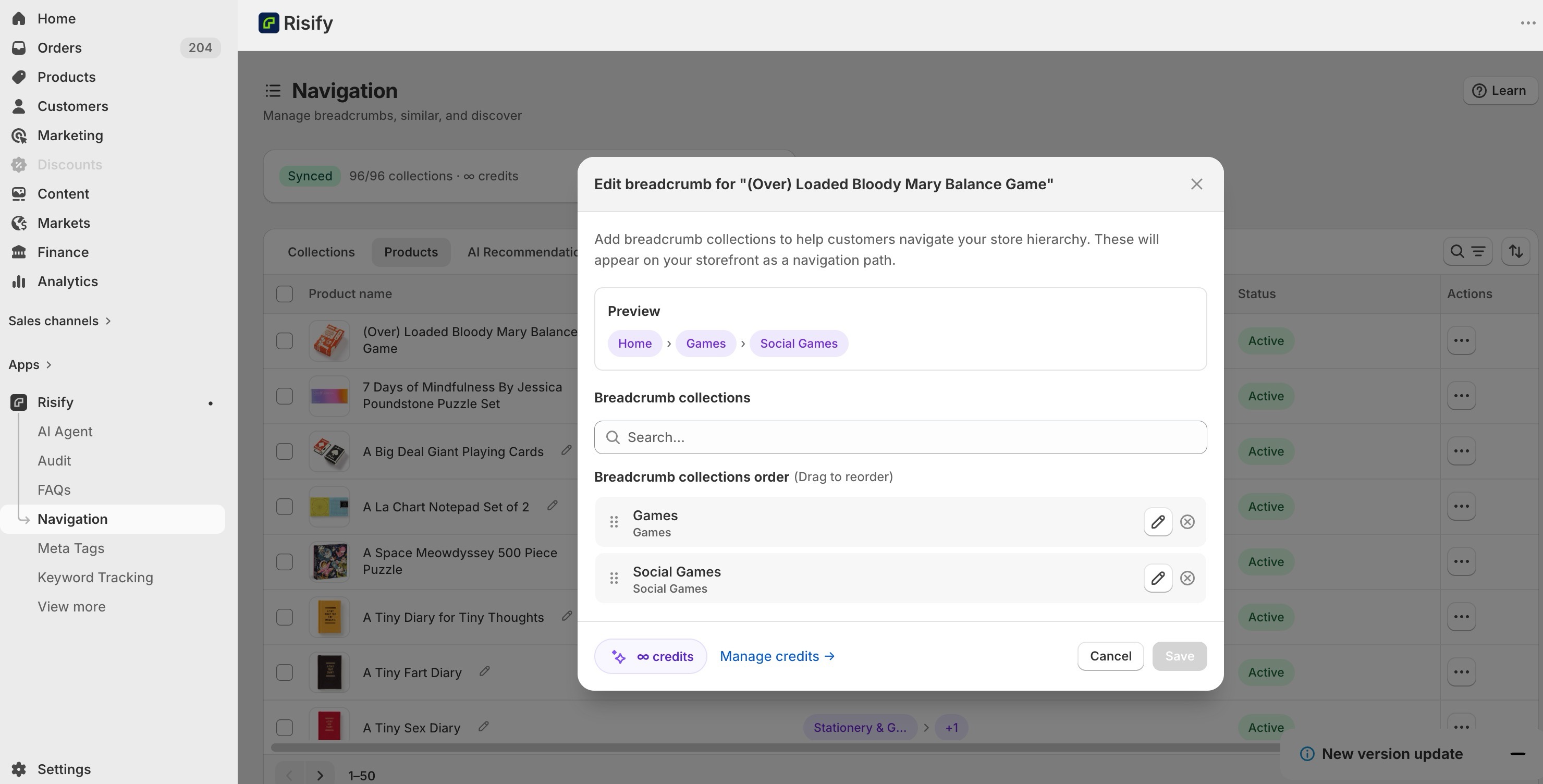
You choose how each product and collection should appear in the hierarchy.
Once set, that path displays for every visitor regardless of how they arrive. No missing breadcrumbs, no inconsistent paths depending on the referrer.
Multi-Level Hierarchy Without Custom Development
Shopify can’t store parent-child relationships between collections natively.
Risify lets you define the full structure yourself. Paths like Home > Cookware > Pots & Pans > Cast Iron > Cast Iron Skillets are straightforward to set up and apply across your entire catalog.
The hierarchy you intended becomes visible to search engines and AI tools.
Automatically-Generated BreadcrumbList Schema
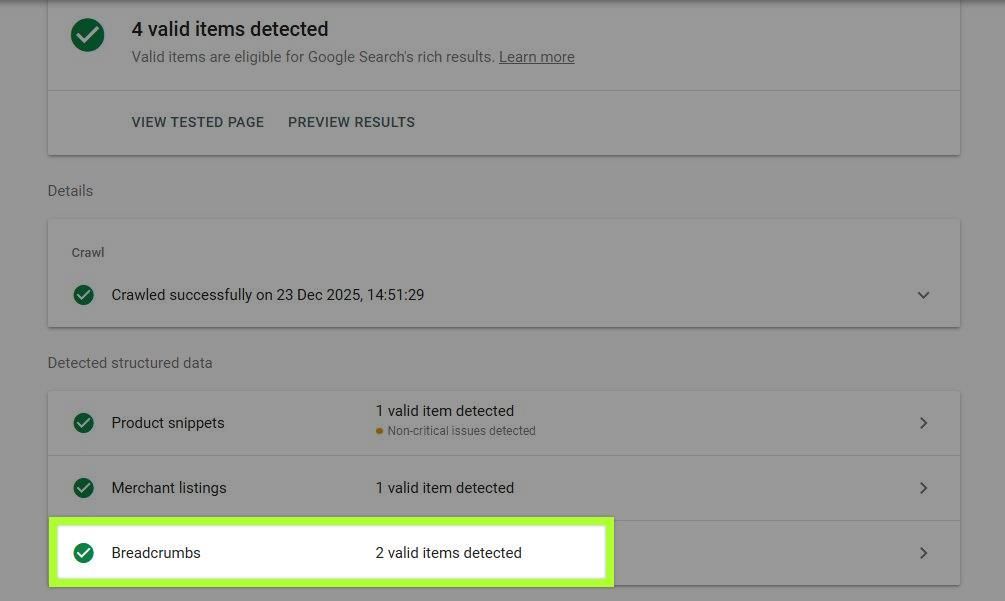
When you define a path, Risify generates valid BreadcrumbList schema behind the scenes.
There’s nothing to maintain separately. What shoppers see on the page and what Google and AI tools read in the structured data always match. If you update a path, both outputs update at the same time.
Your Data Stays in Shopify
Breadcrumb paths are stored in Shopify metafields. The content belongs to your store, so it remains in place even if you ever uninstall Risify.
👉 Learn how to add breadcrumbs to your Shopify store easily
 Help search engines and AI tools understand your structure more clearly
Optimize Your Breadcrumbs Easily
Set up your breadcrumbs in a few clicks and generate schema markup automatically.Conclusion
Breadcrumb schema is one of the clearest hierarchy signals available to search engines and AI platforms. It’s also one of the most commonly missing from Shopify stores.
The reasons are structural: Shopify doesn’t store collection relationships natively, and most themes generate breadcrumbs inconsistently depending on how visitors arrive.
The result is that your catalog’s organization often exists only in your navigation menu. It’s visible to shoppers but invisible to the platforms increasingly driving product discovery.
Defining that hierarchy explicitly, outputting it as a consistent BreadcrumbList schema on every page, and keeping it synchronized with what visitors see is what closes that gap.
For search engines, it strengthens the topical signals that influence category-level rankings. For AI tools, it provides the reliable catalog map they need to represent your products accurately.
If you want to dig deeper into Shopify breadcrumbs, please check out Shopify Breadcrumbs Uncovered.