









Choosing the wrong proxy provider can mean blocked requests, wasted budget, and unreliable data - but the market now has dozens of options with very different strengths. This guide compares seven proxy providers that serve the Ecommerce space in 2026, breaking down what each one offers, what it costs, and where it fits best.
5 Key Takeaways Before You Start
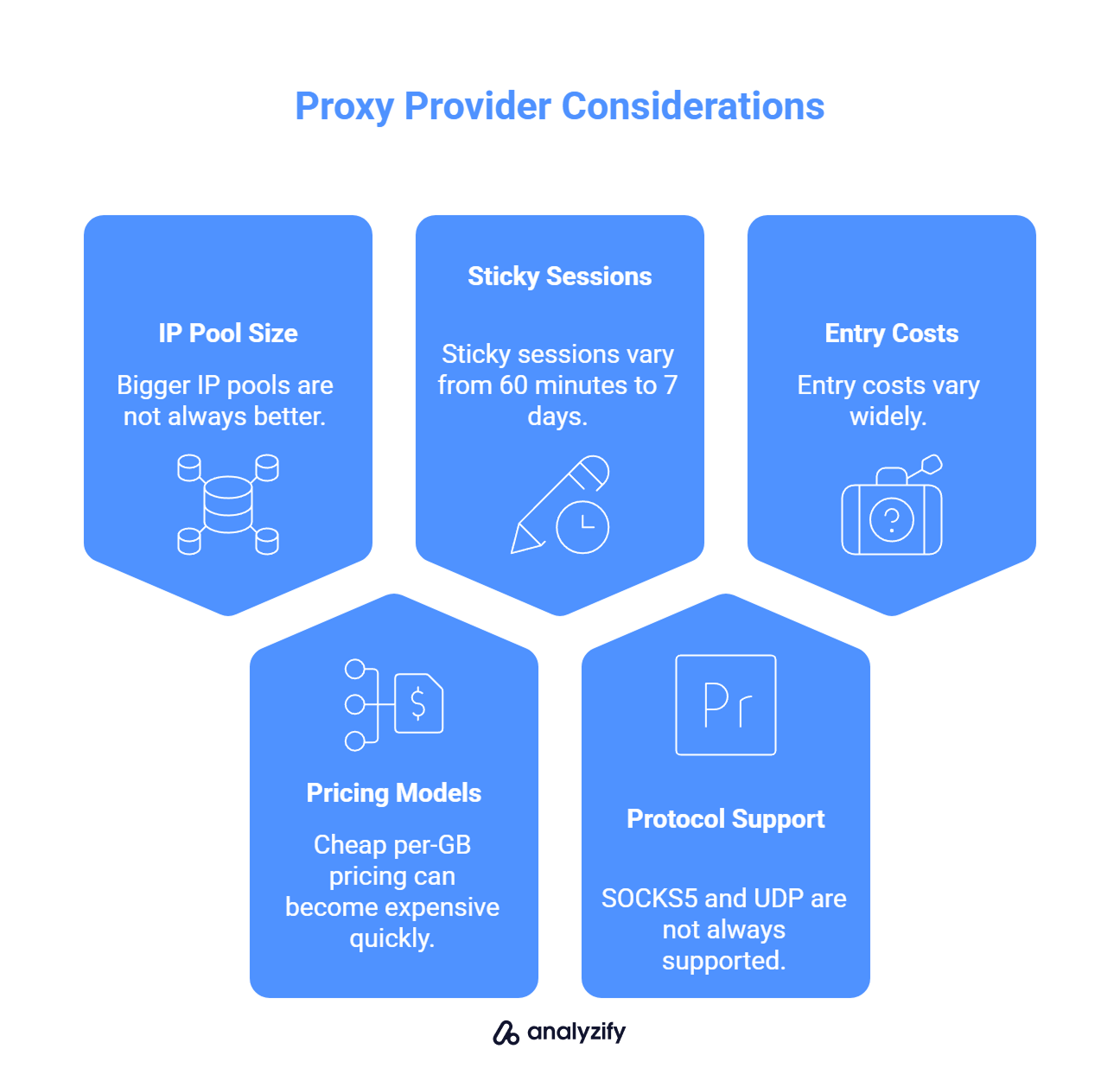
- Bigger IP pools are not always better, since some providers focus on volume while others maintain smaller pools with higher success rates.2.
- Cheap per-GB pricing can become expensive quickly, so compare it with unlimited per-IP plans based on your usage.4.
- Sticky sessions vary from 60 minutes to 7 days, and short limits can break login-based or multi-step workflows.6.
- SOCKS5 and UDP are not always supported, so check protocol compatibility before buying.8.
- Entry costs vary widely, with some providers offering free tiers while others require paid plans with no trial.
Proxy Providers Comparison Table
| Feature | MarsProxies | Bright Data | Decodo | IPRoyal | NodeMaven | Webshare | LiveProxies |
|---|---|---|---|---|---|---|---|
| Founded | N/A | 2014 | 2018 | 2020 | 2023 | 2018 | 2020 |
| Headquarters | Panama | Israel | Lithuania | UAE | Estonia | USA (California) | USA (California) |
| Residential IP Pool | 1M+ | 150M+ | 115M+ | 115M+ (claimed) | 30M+ | 30M+ | 10M+ (enterprise) |
| Proxy Types | Residential, ISP, DC (IPv4/IPv6), Mobile, Sneaker | Residential, ISP, DC, Mobile | Residential, ISP, DC, Mobile | Residential, ISP, DC, Mobile | Residential, Mobile, Static ISP | Residential (static + rotating), DC | Residential (static + rotating), Mobile, DC |
| Residential Price (per GB) | From $3.49/GB | From $2.50/GB (bulk) | From $2.00/GB | From $1.75/GB | From $2.22/GB | From $1.40/GB (sale) | From $45/plan (metered) |
| DC Proxy Price (per IP) | From $0.89/IP | From $0.90/IP | From $0.02/IP | From $1.39/IP | N/A (LiveServers) | From $0.018/IP | From $45/plan |
| ISP Proxy Price (per IP) | From $1.35/IP | From $1.30/IP | From $0.27/IP | From $2.00/IP | Custom | From $0.23/IP | From $65/plan |
| Max Sticky Session | Up to 7 days | Configurable (hours-days) | Configurable (hours-days) | Up to 24 hours | Up to 24 hours | Configurable (per port) | Up to 60 minutes |
| Protocols | HTTP/HTTPS, SOCKS5, UDP/TCP | HTTP/HTTPS, SOCKS5 | HTTP/HTTPS, SOCKS5 | HTTP/HTTPS, SOCKS5 | HTTP/HTTPS (SOCKS5 on request) | HTTP/HTTPS, SOCKS5 | HTTP/HTTPS, SOCKS5 |
| IPv6 Support | Yes | No | No | No | Yes | No | No |
| Geo-Targeting | Country, state, city (190+ countries) | Country, state, city, ZIP, ASN (195 countries) | Country, state, city, ZIP, ASN (195 countries) | Country, state, city, ZIP, ASN (195+ locations) | Country, state, city, ZIP, ASN (150+ countries) | Country, state, city (195+ countries) | Country, state, ZIP (50+ countries) |
| Free Trial | No (minimum purchase required) | Deposit match up to $500 | 3-day / 100 MB free | 3-day / 100 MB free | $3.99 for 1 GB | 10 free proxies / 1 GB per month | 10 free proxies / 1 GB per month |
| Payment Methods | Credit card, PayPal, crypto | Credit card, PayPal, crypto | Credit card, crypto | Credit card, PayPal, crypto | Credit card, crypto | Credit card, crypto | Credit card, crypto |
Best Proxy Providers for E-commerce
The seven providers below cover a wide range of needs, from budget-friendly pay-as-you-go plans to enterprise-grade platforms with hundreds of millions of IPs. Each section breaks down the provider’s background, key features, and pricing so you can compare them side by side.
MarsProxies
MarsProxies offers one of the broadest proxy type selections on this list: rotating residential, static ISP, datacenter (both IPv4 and IPv6), mobile, and dedicated sneaker proxies - all under a single platform. The service covers 190+ countries with over 1 million residential IPs and targets users who need flexible, pay-as-you-go proxy access without monthly subscriptions or long-term contracts.

What sets MarsProxies apart is the combination of proxy variety and billing simplicity. You pick the proxy type, choose how many IPs or how much traffic you need, select a rental period (1, 30, 60, or 90 days), and pay once. There are no recurring charges unless you reorder. Residential proxies are billed per GB with non-expiring traffic, meaning unused data carries over indefinitely. All other proxy types come with unlimited bandwidth included in the per-IP price.
Key features:
- Sticky sessions up to 7 days on residential proxies, which is one of the longest windows among the providers in this comparison. You can also set rotation intervals as short as 1 second, giving you full control over session behavior depending on the task.
- Full protocol coverage across all proxy types: HTTP, HTTPS, SOCKS5, and UDP/TCP on ISP, datacenter, and sneaker proxies. This makes MarsProxies compatible with most automation tools, anti-detect browsers, and custom scripts without needing workarounds.
- IPv6 datacenter proxies at low per-IP rates (starting around $0.32/IP for a 30-day plan). Most providers on this list do not offer IPv6 at all, which limits options if your target sites support or prefer IPv6 connections.
- Dedicated sneaker proxies optimized for retail and ticketing sites, with a reported 98%+ success rate and SOCKS5 support. These are static, dedicated IPs in 30+ locations with unlimited bandwidth and sessions.
- Mobile proxies on real 3G/4G/5G networks (currently UK and US), each dedicated to a single user with automatic rotation roughly every 10 minutes. These carry unlimited data and work well for tasks that require genuine mobile-origin traffic.
- Multiple payment options including credit/debit card, PayPal, Alipay, and cryptocurrency. No account verification or KYC process is required for standard purchases.

Pricing overview:
| Proxy Type | Starting Price | Billing Model |
|---|---|---|
| Residential (rotating) | $3.49/GB (at ~1000 GB volume) | Per GB, non-expiring traffic |
| ISP (static) | $1.35/IP (30-day plan, bulk) | Per IP, unlimited bandwidth |
| Datacenter IPv4 (static) | $0.89/IP (30-day plan, bulk) | Per IP, unlimited bandwidth |
| Datacenter IPv6 (static) | $0.22/IP (30-day plan, bulk) | Per IP, unlimited bandwidth |
| Sneaker (static) | $0.86/IP (30-day plan, bulk) | Per IP, unlimited bandwidth |
| Mobile | $2.83/day (long-term plan) | Per day, unlimited bandwidth |
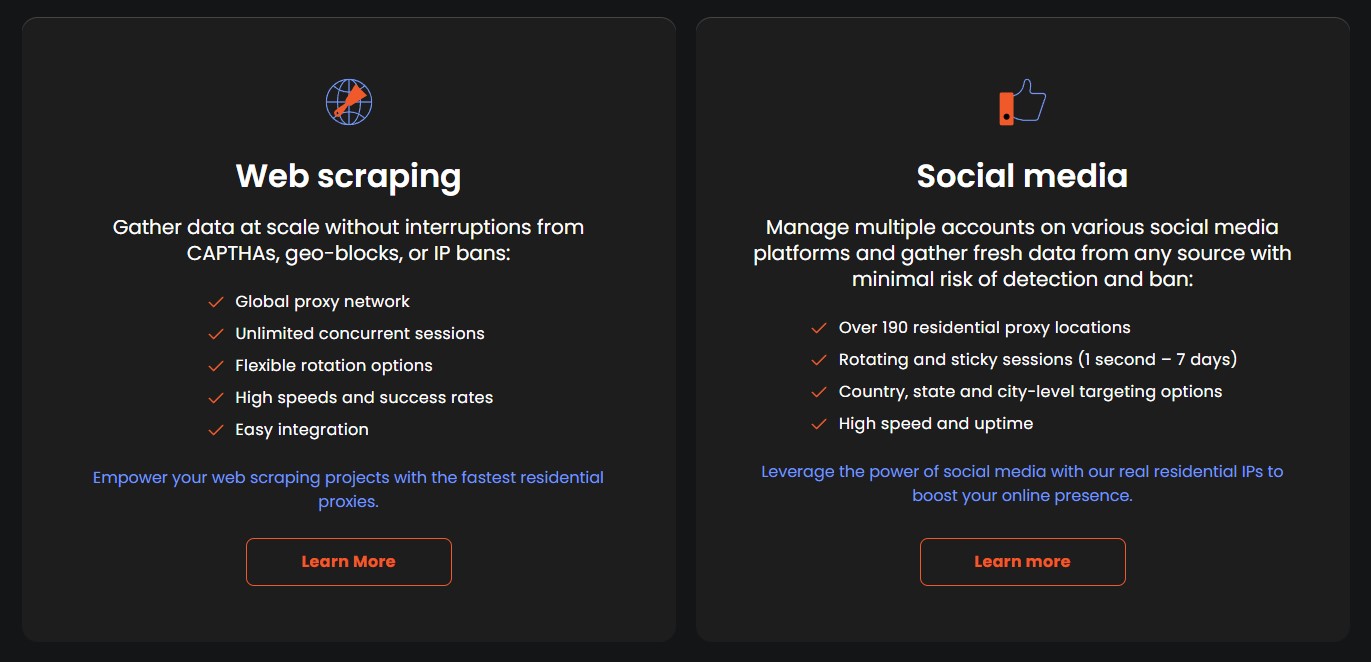 With six distinct proxy categories under one account, MarsProxies covers more use cases from a single dashboard. The pay-once billing model with no recurring charges or contracts makes it especially practical for projects where usage fluctuates month to month - you only spend when you actually need proxies, and unused residential traffic stays in your balance indefinitely.
Bright Data
Bright Data (formerly Luminati) is an Israeli company founded in 2014, making it one of the oldest and most established players in the proxy space. It operates what is arguably the largest proxy network in the industry: 150M+ residential IPs, 7M+ mobile IPs, and 1.3M+ each for datacenter and ISP proxies, all spread across 195 countries.
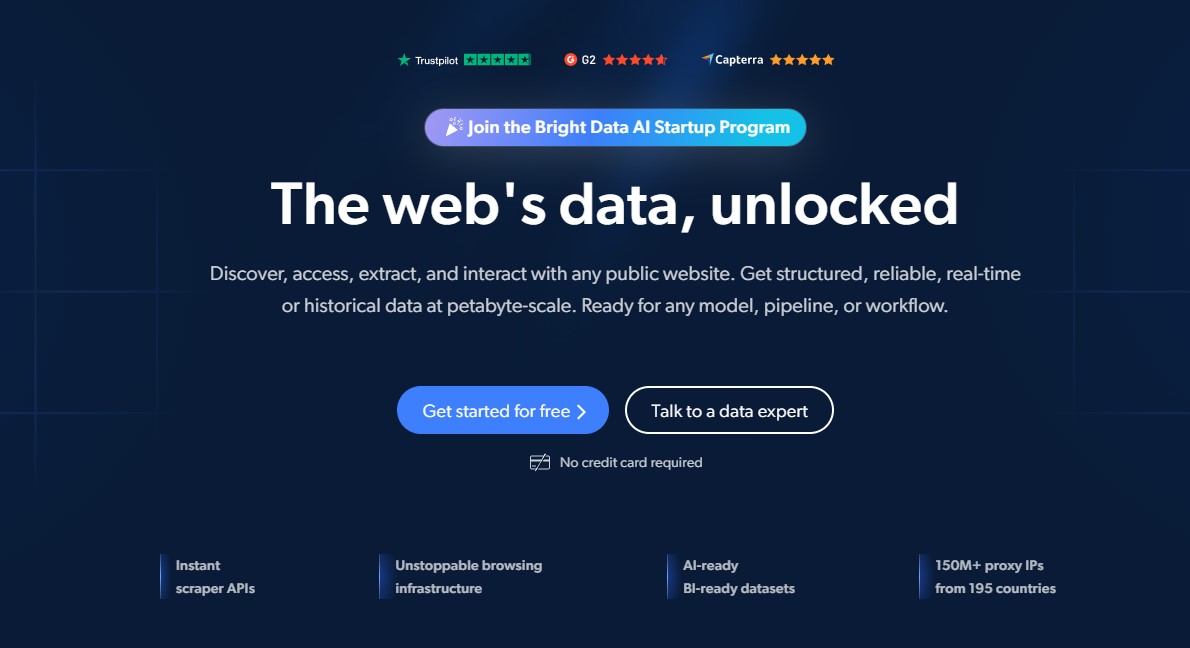
The scale here is hard to match. If you need IPs in a specific city, ZIP code, or ASN in nearly any country, Bright Data likely has coverage. The platform also includes tools like a Proxy Manager for local configuration, a Scraper Studio for no-code extraction, and browser-based APIs for JavaScript-heavy pages.
Key features:
- 150M+ residential IPs with free geo-targeting down to city, state, ZIP, and ASN level. No extra charge for location-specific routing.
- Mobile proxies built on HTTP/3 (QUIC) for faster connections on 3G/4G/5G networks across 195 countries. Unlimited concurrent sessions with no code changes needed.
- Scraping APIs included in the platform: SERP API, Unlocker API, Crawl API, and Browser API, each priced separately. This reduces the need for external scraping tools if you already use Bright Data proxies.
- Ethical sourcing with compliance audits. Bright Data enforces KYC on customers and runs GDPR/CCPA-compliant operations. All residential and mobile IPs come from consenting participants.
- Enterprise support and infrastructure: 24/7 global support team, AWS Marketplace billing integration, and custom SLAs for high-volume accounts.

Pricing overview:
| Proxy Type | Starting Price | Billing Model |
|---|---|---|
| Residential | $2.50/GB (bulk monthly) | Per GB, pay-as-you-go or plans |
| ISP (static) | $1.30/IP per month | Per IP, unlimited traffic |
| Datacenter | $0.90/IP per month | Per IP, unlimited traffic |
| Mobile | $5.00/GB (single-pay) | Per GB, pay-as-you-go |

Bright Data’s entry cost is higher than most providers here. Pay-as-you-go residential pricing starts around $5/GB before bulk discounts, and there is no free tier - only a deposit-match promotion (up to $500 credit). The platform is built for teams and organizations running large-scale, ongoing data collection, not for one-off tasks or tight budgets.
Decodo (formerly Smartproxy)
Decodo rebranded from Smartproxy in 2024 and is based in Lithuania. Founded in 2018, it has built a network of 115M+ residential IPs and 10M+ mobile IPs across 195 countries, along with 500K datacenter IPs. Like Bright Data, Decodo has expanded beyond proxies into scraping APIs and AI-ready data feeds, but its pricing tends to be more accessible for mid-size operations.
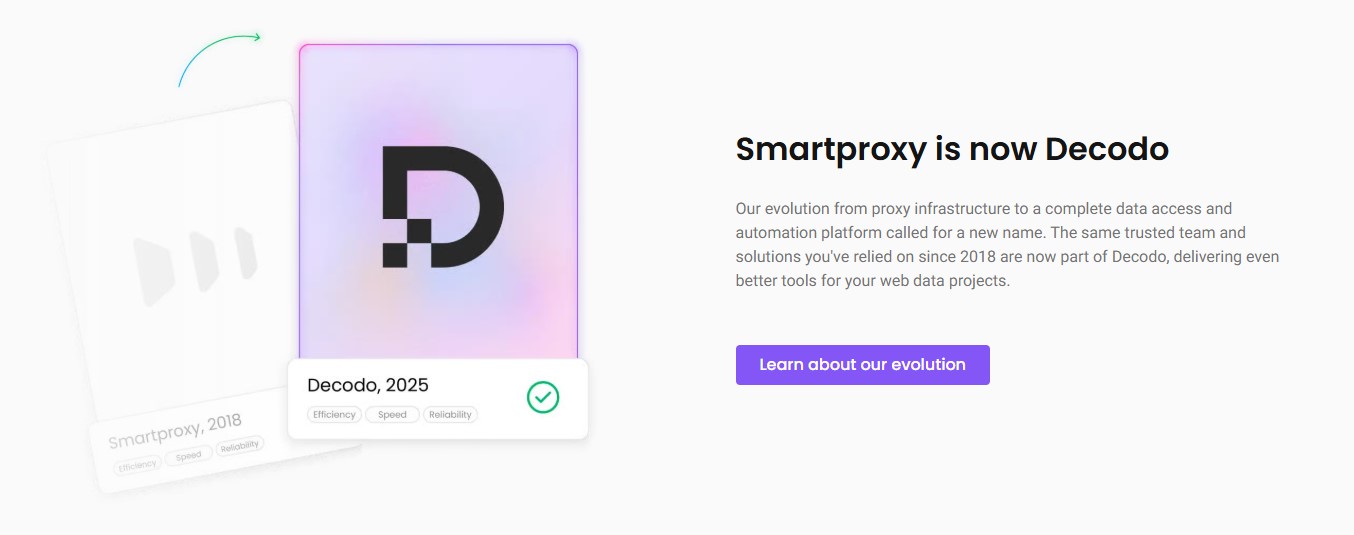
Decodo’s residential proxy performance numbers are strong: under 0.6 seconds average response time, 99.86% success rate, and 99.99% uptime. The platform includes a built-in anti-detect browser (XBrowser) for multi-account management and browser extensions for quick proxy switching.
Key features:
- 115M+ residential IPs with geo-targeting at country, state, city, ZIP, and ASN levels - all included at no extra cost on every plan.
- Mobile proxies from 700+ carriers in 160+ locations, ethically sourced from opt-in users. This is one of the most diverse mobile networks in the comparison.
- ISP proxies with unlimited bandwidth and static IPs that you keep for the duration of your plan. Starting at $0.27/IP, these are among the cheapest ISP proxies available.
- Scraping API suite covering e-commerce, SERP, and social media data extraction, plus an AI parser that converts any page into structured output without custom code.
- 3-day free trial (100 MB) with no credit card required, plus a 14-day money-back guarantee on paid plans.

Pricing overview:
| Proxy Type | Starting Price | Billing Model |
|---|---|---|
| Residential | $2.00/GB (1000 GB plan) | Per GB, monthly plans or pay-as-you-go |
| ISP (static) | $0.27/IP | Per IP, unlimited bandwidth |
| Mobile | $2.25/GB (large plans) | Per GB, monthly plans |
| Datacenter | $0.02/IP | Per IP, unlimited traffic |
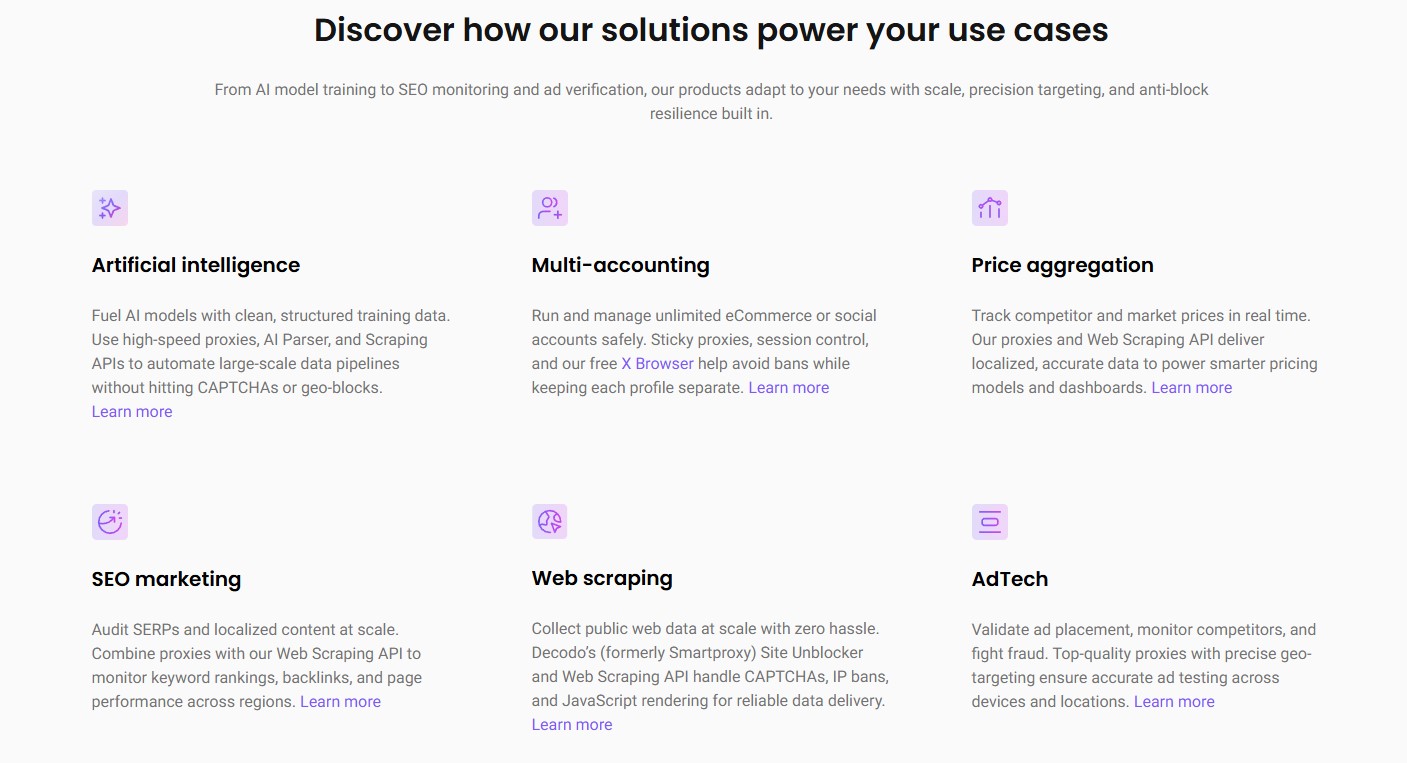
Decodo’s pay-as-you-go rate for residential proxies is $4.00/GB, which drops to $2.00/GB at the 1000 GB tier. That mid-range pricing, combined with a free trial and full scraping API access, makes it a practical choice for teams that need both proxies and data extraction tools under one account without committing to enterprise-level spend.
IPRoyal
IPRoyal launched in 2020 and is headquartered in Ajman, UAE. It offers residential, ISP, datacenter, and mobile proxies, plus two specialized tools: a Web Unblocker API for heavily protected sites and a Video Scraper API for YouTube data extraction. The company claims over 10,000 business customers and emphasizes ethically sourced IPs from consenting users and ISPs.

IPRoyal’s residential pool is listed at 115M+ IPs across 195+ locations, though third-party estimates suggest the actively available pool may be closer to 2 million. Regardless of the exact count, IPRoyal covers all major markets with city, state, ZIP, and ASN-level targeting on residential and ISP proxies.
Key features:
- Residential proxies with sticky sessions up to 24 hours and unlimited concurrent connections. Full geo-targeting (country/state/city/ZIP/ASN) is included on all plans.
- ISP proxies in 24 countries with 10 Gbps speeds, 99.9% uptime, and static IPs you retain for the billing period. These combine residential-level trust with datacenter-level speed.
- Mobile proxies using dedicated SIMs (1.5M+ IPs, currently US/UK/Lithuania). Each mobile proxy is assigned to a single user with unlimited bandwidth and IP rotation via dashboard or API.
- SOCKS5 support on residential and datacenter proxies, expanding compatibility with tools that require non-HTTP protocol routing.
- Free 3-day trial (100 MB) and a 14-day money-back guarantee. Supports credit card, PayPal, and cryptocurrency payments.
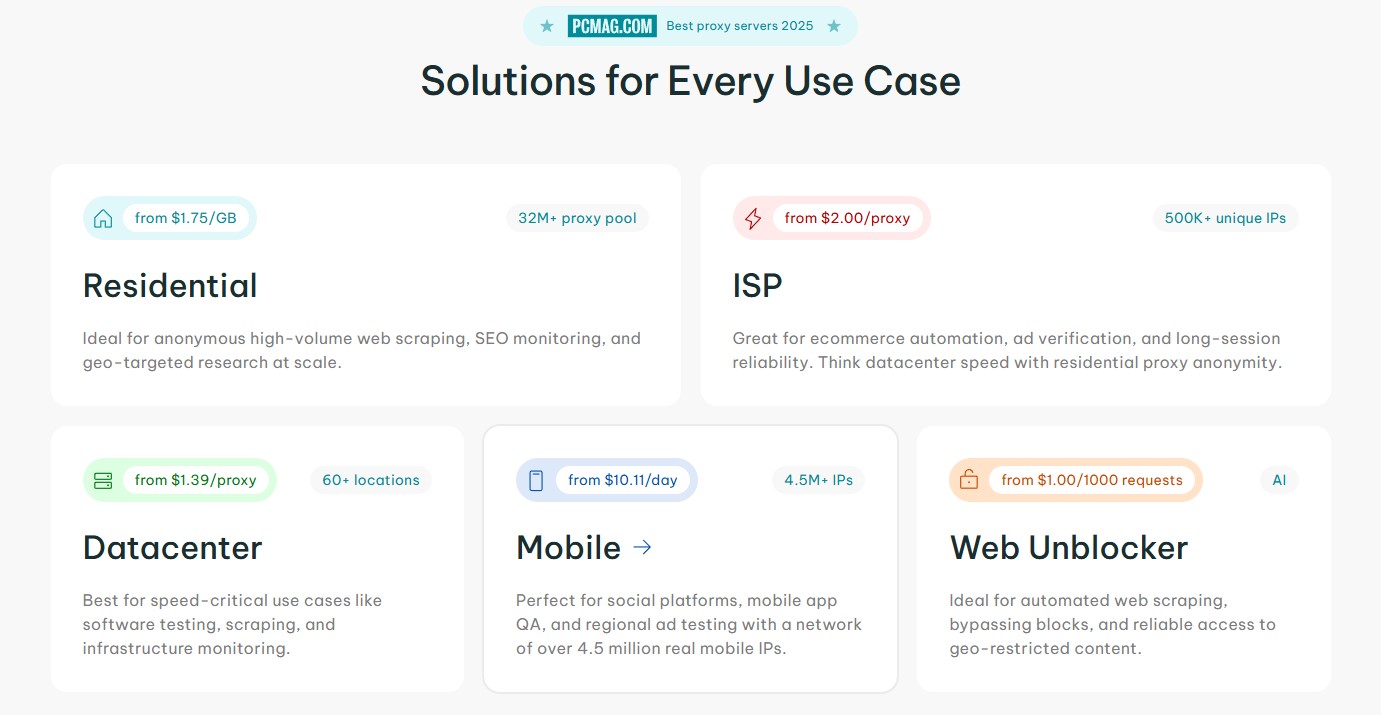
Pricing overview:
| Proxy Type | Starting Price | Billing Model |
|---|---|---|
| Residential | $1.75/GB (large tiers) | Per GB, balance top-up or monthly |
| ISP (static) | $2.00/IP per month | Per IP, unlimited traffic |
| Datacenter | $1.39/IP per month | Per IP, unlimited bandwidth |
| Mobile | $7.00/day (30+ day plan) | Per day, unlimited bandwidth |
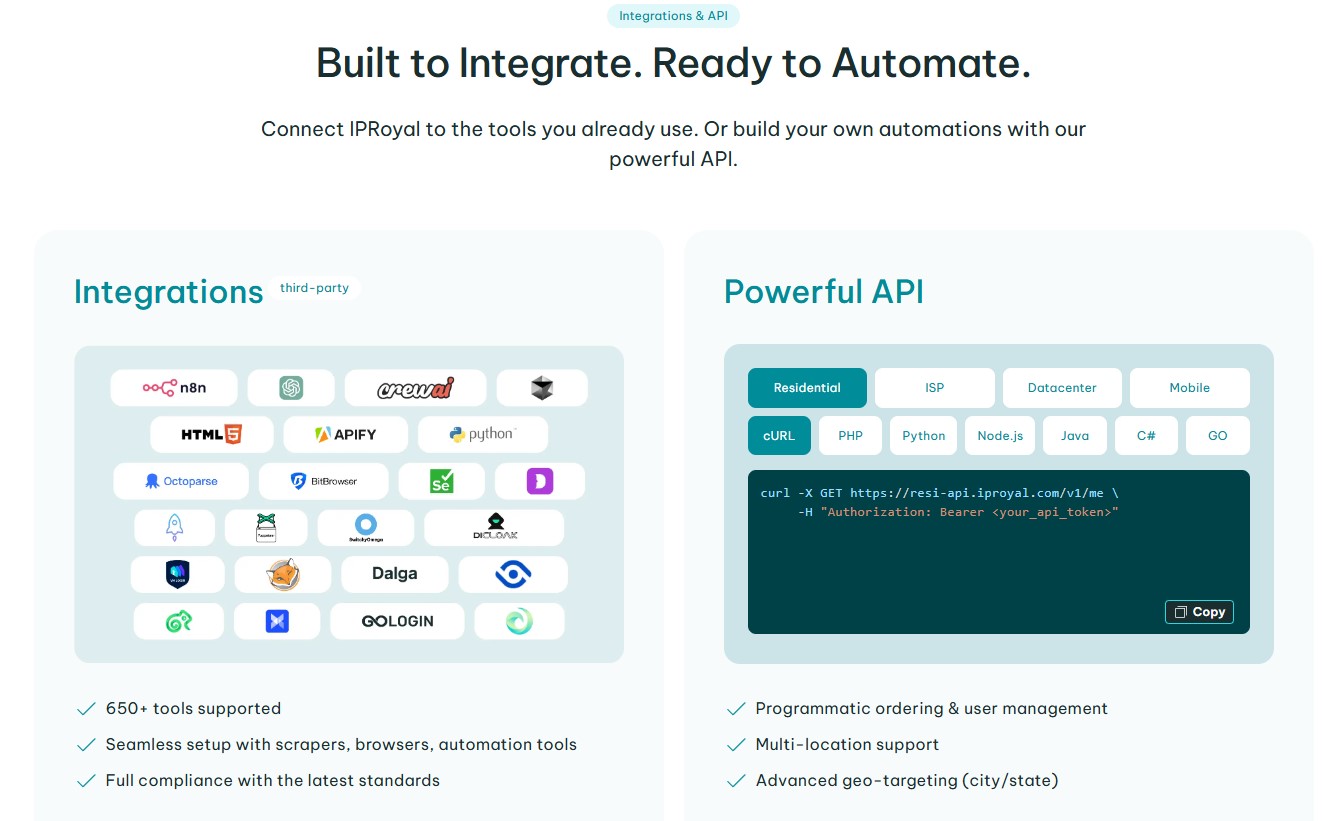
IPRoyal hits a competitive price point on residential proxies ($1.75/GB at scale), and the combination of a free trial, ethical sourcing focus, and team management features (roles, 2FA, usage analytics) makes it a reasonable pick for small-to-mid-size teams that need broad proxy coverage without a steep learning curve.
NodeMaven
NodeMaven is an Estonian company founded in 2023, making it the newest provider on this list. It was built by the team behind Multilogin (a well-known anti-detect browser), and that background shows in its approach: rather than competing on IP pool size, NodeMaven focuses on IP quality filtering.

The quality filtering works through selectable levels (Standard, Strict) that validate IPs against external tools like PixelScan and Proxyway. This means fewer failed connections and higher success rates per request, which matters when you are running account management or session-sensitive tasks where a single bad IP can trigger a ban.
Key features:
- IP Quality Filter with selectable levels, validated by third-party scanning tools. This is NodeMaven’s primary differentiator - you trade raw pool size for higher per-IP reliability.
- Combined residential + mobile pool under a single subscription. You can switch between residential and mobile IPs freely without needing a separate plan or paying extra.
- Sticky sessions up to 24 hours on residential proxies, with full geo-targeting by country, state, city, ZIP, ASN, and carrier.
- Bandwidth rollover on all plans - unused data carries to the next billing cycle. This is uncommon among providers that bill by GB.
- 24/7 support via live chat, email, Slack, Telegram, and Zoom. Advertised response times and uptime figures: >99.99% uptime, <0.5s response.
Pricing overview:

| Proxy Type | Starting Price | Billing Model |
|---|---|---|
| Residential + Mobile | $2.22/GB (high volume) | Per GB, prepaid or subscription |
| Static ISP | Custom pricing | Per IP (introduced Dec 2025) |
| Trial | $3.99 for 1 GB | One-time purchase |

NodeMaven’s pool is smaller than the large providers, and its static ISP proxies only launched in late 2025 with limited public pricing. But if your priority is connection quality over volume - especially for multi-account management, social media, or affiliate marketing tasks where IP fingerprint matters - the filtering approach delivers measurable value that bigger pools do not automatically provide.
Webshare
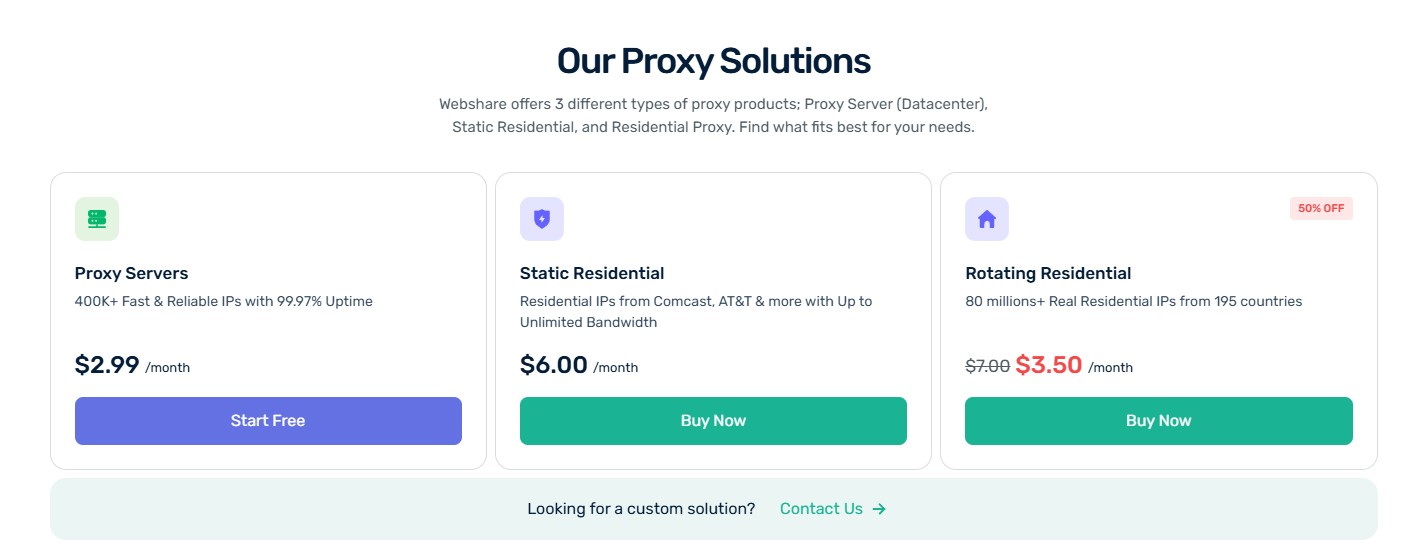
Webshare was founded in 2018 and is based in California, USA. In 2022, it was acquired by Oxylabs, one of the larger players in the proxy industry. Webshare’s focus is straightforward: affordable proxies with a clean dashboard and API. It offers both residential proxies (static and rotating) and datacenter proxies (shared, private, and dedicated tiers), covering 195+ countries with a claimed pool of 30M+ IPs.
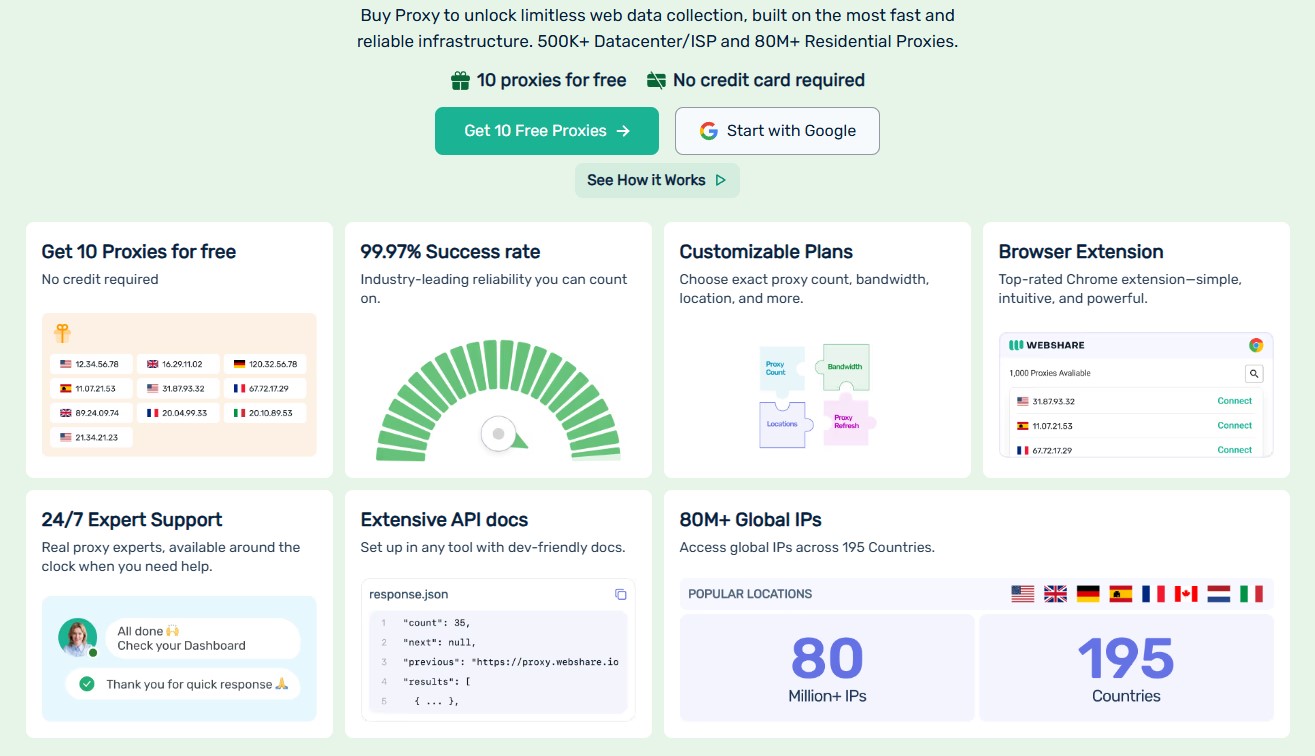
Webshare does not offer mobile proxies, which is a notable gap compared to others on this list. But where it competes strongly is on price - its datacenter proxies start at $0.018/IP, and rotating residential proxies drop to $1.40/GB during promotional pricing. The platform includes a free tier (10 proxies or 1 GB/month), making it one of the easiest providers to test without any payment.
Key features:
- Free proxy tier with up to 10 proxies or 1 GB of traffic per month. No credit card required. This is the most accessible entry point among all seven providers.
- Static and rotating residential proxies with per-port session control. Each proxy port can be configured as sticky (fixed IP) or rotating, giving you granular control without extra settings.
- Extremely low datacenter proxy pricing starting at $0.018/IP (shared). Private datacenter proxies run $0.43/IP, and dedicated ones $0.77/IP.
- SOCKS5 support on rotating residential and datacenter proxies, alongside standard HTTP/HTTPS.
- Team management features including multi-user accounts, role assignments, and two-factor authentication. API access is available for proxy list management and automation.
Pricing overview:
| Proxy Type | Starting Price | Billing Model |
|---|---|---|
| Residential (static) | $0.23/IP | Per IP, monthly |
| Residential (rotating) | $1.40/GB (sale price) | Per GB, pay-as-you-go |
| Datacenter (shared) | $0.018/IP | Per IP, unlimited usage |
| Datacenter (private) | $0.43/IP | Per IP, monthly |
| Datacenter (dedicated) | $0.77/IP | Per IP, monthly |
| Free tier | $0 | 10 proxies or 1 GB/month |

Webshare is the budget pick on this list. If you need affordable datacenter proxies for high-volume scraping, or want a free tier to prototype with before scaling, it covers those needs well. The lack of mobile proxies and IPv6 support limits it for certain use cases, but for price-sensitive projects focused on residential or datacenter access, it is hard to beat on cost.
LiveProxies
LiveProxies was founded in 2020 and operates out of California, USA. It started as a provider for sneaker-botting communities and has since expanded to serve a broader audience, claiming over 10,000 paid users. Its product line includes rotating and static residential proxies, rotating mobile proxies, and dedicated datacenter servers (branded as “LiveServers”) with 10+ Gbps uplinks.
LiveProxies’ coverage spans 50+ countries, which is narrower than most providers in this comparison. Its IP pool size is also less transparent - the 10M+ figure is only referenced for enterprise/B2B accounts, and no specific number is published for individual plans. The platform does include a free tier (10 proxies or 1 GB/month), a Discord community for support, and browser extensions for Firefox and Chrome.
Key features:
- Static residential proxies (US only) with fixed IPs reserved for 30+ days, unlimited bandwidth, and concurrent sessions. These are designed for long-session tasks like social media management or trading platforms.
- LiveServers (datacenter proxies) with dedicated virtual machines, 10+ Gbps bandwidth, and static IPs. A Canadian private proxy pool is available alongside global locations.
- Rotating residential proxies with 60-minute sticky sessions and unlimited bandwidth on paid plans. IPs come from a peer-to-peer network of real devices.
- Free proxy tier offering 10 proxies or 1 GB per month for basic testing.
- 24/7 support via live chat and Discord, with an active user community (700+ verified Discord members).

Pricing overview:
| Proxy Type | Starting Price | Billing Model |
|---|---|---|
| Rotating residential | From $45/plan (200 IPs, 4 GB, 30 days) | Monthly, metered bandwidth |
| Static residential (US) | From $65/plan (200 IPs, 4 GB, 45 days) | Monthly, per IP |
| LiveServers (shared) | From $45/plan | Monthly, per server |
| LiveServers (dedicated) | From $65/plan | Monthly, per server |
| Free tier | $0 | 10 proxies or 1 GB/month |

LiveProxies’ pricing structure is less granular than most competitors - plans are sold as bundles (IP count + bandwidth + duration) rather than pure per-GB or per-IP rates, which makes direct price comparison harder. The 60-minute sticky session cap on rotating proxies is the shortest on this list.
That said, if you need dedicated US residential IPs with unlimited bandwidth, or high-throughput datacenter servers with premium uplinks, LiveProxies covers those specific needs at reasonable plan-level pricing.
What to Look for When Choosing a Proxy Provider
Proxy providers can look similar on the surface - most list residential IPs, geo-targeting, and SOCKS5 on their feature pages. The differences that actually affect your results show up in how those features are implemented, priced, and maintained.
IP Pool Size vs. IP Quality
A large IP pool does not automatically mean better performance.
Bright Data and Decodo both offer 100M+ residential IPs, giving you massive address diversity across nearly every country. That scale matters when you need to rotate through thousands of unique IPs per hour without repeating. But NodeMaven, with a smaller 30M+ pool, applies multi-layer quality filtering that removes unreliable IPs before they reach your connection - often resulting in higher success rates per request.
How to decide:
- Volume-heavy scraping (millions of requests, dozens of countries) - prioritize large pools
- Session-sensitive tasks (account logins, checkout flows, multi-account management) - prioritize filtered, high-reliability pools
- Mixed workloads - look for providers that let you toggle between pool size and quality settings per request
Session Duration and Rotation Control
Sticky session length varies from 60 minutes to 7 days across this list. That range directly limits what you can do with a proxy.
A 60-minute window (LiveProxies) may not be enough if your task involves logging in, navigating multiple pages, and completing a transaction on a slow site. A 7-day window (MarsProxies) gives room for extended sessions like account warming or multi-step verification flows.
What to check:
- Can you set sticky duration per request, or is it fixed for the whole plan?
- Does the provider support both long sticky windows (for persistence) and per-request rotation (for anonymity)?
- What happens when a sticky session expires mid-task - does the connection drop, or does it silently rotate to a new IP?
Pricing Model Fit
The cheapest per-GB rate is not always the cheapest total cost.
Residential proxies billed per GB work well for lightweight tasks - SERP scraping, price checks, API calls. But loading full pages with images, scripts, and video can burn hundreds of megabytes per session. In that case, a per-IP model with unlimited bandwidth (static ISP or datacenter proxies) may cost less overall.
Quick cost comparison by billing type:
- Per-GB billing (MarsProxies, Bright Data, Decodo, IPRoyal, NodeMaven) - best for low-bandwidth, high-request tasks
- Per-IP billing with unlimited data (ISP and datacenter plans from most providers) - best for bandwidth-heavy tasks with fewer unique IP needs
- Bundle billing (LiveProxies) - plans sold as IP count + bandwidth + duration packages, harder to compare directly
Also check for hidden costs. Some providers charge extra for geo-targeting, SOCKS5 access, or API usage that others include by default.
Protocol and Integration Requirements
HTTP/HTTPS covers most scraping and browser-based tasks, but it is not always enough.
- Anti-detect browsers (Multilogin, GoLogin) often route traffic through SOCKS5 by default. If your provider does not support it, the browser will not connect.
- UDP traffic (DNS lookups, game clients, streaming) requires explicit UDP/TCP support alongside SOCKS5. MarsProxies is one of the few on this list that supports all four protocols on ISP and datacenter proxies.
- IPv6 can matter if your target sites serve different content or apply different rate limits on IPv6 connections. Most providers here are IPv4-only. MarsProxies and NodeMaven are the exceptions.
Before committing, test your exact tool stack against the provider’s protocol support - not just what the feature page says, but whether your specific browser, bot, or script connects successfully.
Geographic Coverage Depth
There is a difference between listing 195 countries and having usable IP depth in those countries.
A provider might show a country in its location menu but only hold a few hundred IPs there, resulting in slow connections and repeated IP reuse. This matters most for e-commerce monitoring where you need city or ZIP-specific data - delivery fees, regional pricing, local product availability.
Coverage tiers across this list:
- Deep coverage (city/ZIP/ASN targeting): Bright Data, Decodo, IPRoyal, NodeMaven - all support sub-country targeting in major markets
- Broad coverage (country/state/city): MarsProxies, Webshare - 190+ countries with city-level targeting where available
- Narrower coverage: LiveProxies - 50+ countries, state/ZIP targeting in select regions only
If your tasks are US or EU-focused, most providers will have enough depth. If you need IPs in smaller markets (Southeast Asia, Africa, Latin America), verify the actual IP count per country before buying.
Trial Access and Risk Reduction
Testing with a sample request is not the same as testing under real workload.
A 100 MB trial gives you a few hundred requests - enough to confirm the proxy connects, but not enough to evaluate success rates, speed consistency, or IP diversity under load.
What each provider offers for evaluation:
- Ongoing free tier (1 GB/month): Webshare, LiveProxies - lets you run lightweight production tasks indefinitely
- Short free trial (3 days, 100 MB): Decodo, IPRoyal - quick test, limited volume
- Low-cost paid trial: NodeMaven ($3.99 for 1 GB)
- Paid purchase required: MarsProxies (minimum 1 GB at $4.99), Bright Data (deposit-match up to $500)
If you are comparing multiple providers in parallel, start with those offering free or low-cost trials under realistic conditions. Run your actual scraping scripts or automation workflows, not just a curl request to check if the IP responds.
Conclusion
No single proxy provider is the right fit for every project. The seven providers in this guide each solve different problems at different price points - from massive IP networks built for enterprise-scale data collection, to filtered pools tuned for session reliability, to budget-friendly datacenter plans that cost less than two cents per IP.
The best way to choose is to work backward from your actual use case. Map out what proxy types you need, how much bandwidth your tasks consume, how long your sessions need to stay alive, and which countries you need real coverage in - not just listed coverage. Then compare those requirements against the specific pricing models, session limits, and protocol support each provider offers.
If you are still unsure after narrowing the list, take advantage of the free tiers and trial offers before scaling up. A few hours of testing with your real tools and workflows will tell you more than any feature comparison table.